Understanding connected worker solutions: Expectations vs. reality
What you’ll learn:
- The challenge isn’t only that the work is more complex; it’s that the knowledge needed to do the work well is often scattered across people, systems, binders, and spreadsheets.
- Connected worker solutions are not just another digital tool being pushed onto the shop floor.
- It’s important to recognize that these platforms are not a single capability. They are usually a collection of related capabilities.
Editor’s note: This is the first of three articles by ARC Advisory Group research director Inderpreet Shoker on the evolving journey for new-age digital workers and what expectations likely will be of humans in manufacturing paired with industrial technology, namely AI and its real-world adoption.
If you work in manufacturing, this is not news to you: The job keeps getting more complicated. Operators are dealing with more product variation and faster changeovers. Maintenance teams are supporting equipment that is more automated and more connected than ever. Quality and safety requirements are getting stricter.
See also: Beyond technical expertise: Supporting the critical role of system integrators
The challenge isn’t only that the work is more complex; it’s that the knowledge needed to do the work well is often scattered across people, systems, binders, and spreadsheets.
When that knowledge is hard to find or inconsistent from shift to shift, even routine work can become slower, riskier, and more dependent on who happens to be available at that moment.
And on top of all that, a lot of experienced people are retiring, taking years of practical “how we actually get this done” knowledge with them.
Why connected worker solutions are gaining attention
The contrast between industrial technology and consumer technology highlights a major gap. Outside the plant, people are used to phones, apps, maps, banking tools, shopping sites, and messaging platforms that are simple, fast, and personalized.
 dreamstime_xxl_110572185
They can search, swipe, scan, and get answers in seconds. Inside the plant, the experience can feel very different. A worker may have to move between an HMI, a binder, a maintenance system, a quality form, and a spreadsheet just to complete one task.
Although industrial technology has improved significantly, workers still have to navigate older equipment, safety constraints, validation requirements, cybersecurity rules, and systems that were never designed to talk to each other.
The result is that industrial workers are surrounded by more digital tools than before, but those tools do not always make the work easier. In many cases, workers are still trying to keep up with the pace of change while the technology around them feels harder to use than what they carry in their own pockets.
That is the real reason connected worker solutions are getting attention. They are not just another digital tool being pushed onto the shop floor. When designed and deployed well, these solutions can help workers get the right instruction, the right context, and the right help at the right time.
See also: Study sees AI 'maturity gap,' finds companies lack capacity to implement agents
ARC Advisory Group’s recent digital worker research backs up this shift. ARC describes digital/connected worker technologies as tools that give industrial employees access to colleagues, work instructions, training resources, systems, and assets while the work is happening.
That framing matters because it keeps the focus where it belongs: not on the device, the screen, or the buzzwords, but on helping frontline teams do the work more consistently, safely, and efficiently.
Although connected worker solutions are still a relatively new segment in the industrial software market, many vendors describe these platforms as if they can instantly create a paperless, fully optimized factory. End users should take a more practical view and focus on what these solutions can and cannot do.
Although industrial technology has improved significantly, workers still have to navigate older equipment, safety constraints, validation requirements, cybersecurity rules, and systems that were never designed to talk to each other.
While the definition of connected worker solutions is becoming clearer, it is important to recognize that these platforms are not a single capability. They are usually a collection of related capabilities, which means they can mean different things to different people and organizations.
Connected worker software as an execution layer
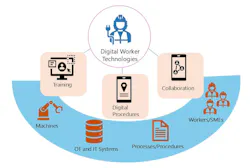
ARC segments this market into three broad categories based on the primary capability delivered to frontline teams: collaboration, training, and work instructions. These categories help clarify a market that often uses overlapping terminology and where many platforms combine multiple capabilities in a single solution.
- Collaboration: Collaboration software enables real-time communication, knowledge sharing, and coordinated task management among field and plant employees, supervisors, and support staff.
- Training: Connected worker platforms may include centralized training resources that organize required training, support role-based learning, and deliver context-specific guidance based on the task, event, or work environment.
- Work Instructions: Digital work instructions provide interactive procedures, manuals, or SOPs that give workers step-by-step guidance in real time. These instructions can include images, videos, checklists, and augmented reality markers to support easier understanding and more consistent execution.
These categories help clarify the market, but they also point to a broader role for connected worker software as an execution layer. Enterprise systems may hold the plan, the schedule, the asset record, or the official quality data.
See also: The missing link between AI strategy and operational reality
But when someone is standing in front of a machine, they still need to know what to do next, how to do it correctly, what information to capture, and when to call for help. Connected worker tools sit in that gap between the system and the actual work. They turn instructions, data, and collaboration into something useful at the point of execution.
Where deployment gets real
Still, a fast-growing market does not guarantee results inside a plant. Even a strong connected worker solution will not fix poor procedures, bad master data, unclear ownership, or a culture where people are not comfortable raising problems.
It also will not replace supervisors, engineers, maintenance experts, quality leaders, or safety professionals who have left the building. These tools are best viewed not as substitutes for people, but as a means to remove unnecessary friction from their work.
They can’t make every judgment call for an experienced technician, understand every nuance of a production issue, or replace the leadership role of supervisors and plant managers.
Even a strong connected worker solution will not fix poor procedures, bad master data, unclear ownership, or a culture where people are not comfortable raising problems.
What these solutions can do is make the right information easier to find, reduce time spent searching for procedures, guide less experienced workers through standard tasks, and help teams capture problems and improvements closer to where the work occurs.
See also: AI has a trust—not a technology—problem
Those productivity gains only materialize when the underlying processes are designed carefully around the realities of the job, with clear ownership, usable instructions, relevant data, and feedback from the workers who will depend on the system every day.
People and process still determine value
End users often understand that processes need to be updated, but those processes are frequently redesigned, digitized, or upgraded with too little consideration for the people who must use them every day and who are ultimately responsible for making the implementation successful.
A workflow may look cleaner on a process map, but if it adds friction for an operator, creates extra administrative work for a technician, or fails to reflect how work actually happens on the floor, adoption will suffer.
The best projects usually start with a specific operational pain point, not a broad digital transformation slogan. Maybe the goal is to reduce rework on one assembly process. Maybe it is to improve maintenance handoffs. Maybe it is to standardize inspections across several lines.
Whatever the starting point, the team needs to define the workflow, decide who owns the content, understand what systems need to connect, and involve the people who will actually use the tool.
Real operational value and ROI come when frontline workers are engaged early, their practical knowledge is reflected in the design, and the new process makes the work easier, more consistent, and more valuable to the business.
The productivity question: What gets easier?
A simple test for any connected worker use case is this: What gets easier for the worker, the supervisor, or the plant? If the answer is not clear, the use case probably needs more work.
Good questions include: What job are we trying to improve? What does the worker need to know at the point of work? What decision or action should be easier? And how will we know the workflow is actually better?
See also: Physical AI: Where opportunity really sits—now, today—for manufacturers
The foundation for a successful connected worker implementation becomes even more important as AI, copilots, and agentic capabilities enter the picture.
While AI can enhance connected worker solutions, it will not make weak workflows strong. It needs trusted content, clean context, and integration with the systems that matter. Otherwise, it may simply add a smarter-looking interface on top of the same old problems.
Once manufacturers understand where connected worker solutions can improve execution, the next question is how AI should fit into that environment. In practice, these questions are already emerging together.
While AI can enhance connected worker solutions, it will not make weak workflows strong. It needs trusted content, clean context, and integration with the systems that matter.
End users are not only evaluating connected worker platforms; they are also being asked to consider how generative AI, copilots, and emerging agentic capabilities could change frontline work. (That will be the focus of the second article in this series, which looks at the AI layer in connected worker solutions and separates practical opportunities from vendor overpromise.)
For manufacturers, the takeaway is simple: Connected worker solutions can create real value, but only when they are treated as part of how work gets improved, not as a shortcut around that work.
The goal is not to put screens on the shop floor for the sake of it. The goal is to make work easier to do correctly, easier to support, and easier to connect with the rest of the industrial enterprise. That is the practical foundation needed before the next layer of AI-enabled frontline operations can deliver on its promise.
About the Author
 Inderpreet Shoker
Inderpreet Shoker
Inderpreet Shoker performs research for ARC Advisory Group and consults with clients in the areas of asset performance management, asset integrity management, plant asset management, and asset reliability. She also leads the research on augmented reality and other extended reality technologies at ARC.