The AI layer in connected worker solutions: Promise and practicality
What you’ll learn:
- Connected worker solutions already help standardize procedures, capture task data, and connect workers to experts.
- AI can build on these capabilities by interpreting operational context and help workers make better decisions faster.
- AI chatbots are already common in industrial settings, but the market is moving beyond simple question-and-answer tools.
Editor’s note: This is the second of three articles by ARC Advisory Group research director Inderpreet Shoker on the evolving journey for new-age digital workers and what expectations likely will be of humans in manufacturing paired with industrial technology, namely AI and its real-world adoption.
The first article in this series, Understanding connected worker solutions: Expectations vs. reality, set the stage. It clarified what connected worker solutions are—and what they are not. These platforms are not a magic layer placed on top of the plant floor.
They create value when they give frontline teams the right instruction, context, and support at the right moment, backed by sound workflow design, integration, data discipline, and change management.
This article builds on that foundation by examining what changes when AI becomes an active part of frontline execution and where the promise of connected worker platforms and AI capabilities needs to be balanced with the realities of industrial deployment.
See also: DX is diminished if your workforce isn’t upskilled
Connected worker solutions already help standardize procedures, capture task data, and connect workers to experts. AI can build on these capabilities by interpreting operational context and help workers make better decisions faster. It can also help address one of industry’s most urgent workforce challenges: Preserving experienced knowledge as senior workers retire while helping newer workers become productive more quickly.
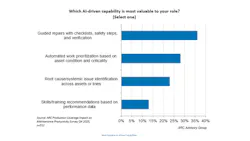
ARC’s Production Coverage Impact on Maintenance Productivity Survey, conducted in the fourth quarter of 2025, found that guided repairs with checklists, safety steps, and verification were the most valuable AI-driven capability identified by respondents.
See also: Smart Industry's annual State of Initiative Survey is open!
The message is clear: Industrial users are not looking for AI dashboards alone. They want AI that helps work get done correctly, safely, and consistently. That’s where co-pilots, generative AI, and agentic AI enter the discussion, not as replacements for connected worker fundamentals, but as capabilities that depend on those fundamentals.
Consider a maintenance technician responding to a recurring pump vibration alarm. In a conventional workflow, the technician may need to open the EAM system, review the work order, search work history, find the maintenance manual, check historian data, read prior shift notes, and call a senior technician to determine whether the failure pattern has occurred before.
In an AI-enabled connected worker environment, the platform could summarize recent alarms, compare symptoms with prior failures, retrieve the relevant lockout/tagout procedure, identify the correct inspection checklist, flag availability of spare parts, and suggest likely next diagnostic steps. The worker still performs the task and applies judgment, but the time spent searching for context drops dramatically.
Podcast: Scaling AI won't fix a shaky ERP foundation
This distinction matters. The most useful AI layer is not a generic chatbot bolted onto a work instruction system. It’s a contextual intelligence layer connected to assets, procedures, work orders, training records, and operational events.
Without that context, AI may provide fluent but shallow answers. With it, AI can help turn connected worker software from a documentation tool into a practical decision-support environment for operations, maintenance, quality, and safety teams.
AI chatbots are already common in industrial settings, but the market is moving beyond simple question-and-answer tools. In connected worker technology and other industrial domains, AI is increasingly embedded into applications to summarize equipment histories, recommend work priorities, generate structured documentation, support training, and coordinate action across maintenance, operations, quality, and safety.
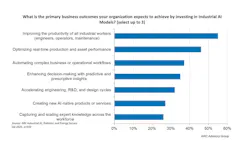
ARC’s Industrial Artificial Intelligence Survey, also from Q4 2025 and based on 559 respondents, reinforces this practical view of AI. The leading business driver for industrial AI was productivity and efficiency improvement, selected by 53% of respondents.
That aligns closely with connected worker priorities. The AI layer should not be framed as an abstract technology upgrade. It should be tied to measurable outcomes such as improved production efficiency, higher first-time-fix rates, reduced downtime, faster onboarding, and better knowledge retention.
Practical AI use cases for frontline work
ARC Advisory Group’s recent digital worker research highlights that the most credible AI use cases in connected worker solutions augment human work rather than bypass it. They help workers find, understand, document, and act on information while keeping accountability with the appropriate human role. Practical examples include:
- Knowledge search and synthesis: AI can search across SOPs, manuals, training content, engineering documents, asset histories, and troubleshooting guides to answer frontline questions in natural language.
- Equipment history summaries: AI can summarize work orders, alarms, inspection findings, condition monitoring data, and prior corrective actions so technicians understand the asset context before starting work.
- Procedure and checklist assistance: AI can help identify the correct procedure, explain unfamiliar steps, translate technical terminology into plain language, and highlight required safety or quality checks.
- Exception documentation: Workers can dictate observations, capture photos, or enter short notes while AI helps convert that input into structured records for maintenance, quality, or continuous improvement teams.
- Next-best-action recommendations: AI can suggest likely follow-up steps based on symptoms, prior cases, asset criticality, and established procedures, while leaving final judgment to qualified personnel.
- Training and competency support: AI can personalize guidance based on worker skill level, past task performance, or certification requirements, helping organizations accelerate onboarding and reduce dependence on informal tribal knowledge.
Where expectations can get ahead of reality
The connected worker market is now filled with references to generative AI, co-pilots, AI agents, autonomous workflows, and digital experts. As discussed in the previous article, connected worker solutions should not be treated as instant transformation platforms. The same caution applies even more strongly to AI.
See also: AI can't replace manufacturing’s biggest competitive advantage: Institutional knowledge
A chatbot that searches a manual is not the same as an AI agent that coordinates a work order across an EAM system, spare parts inventory, scheduling application, and quality workflow. The difference matters because the technology, integration effort, governance requirements, and risk profile are not the same.
There are several areas where expectations around connected worker platforms and AI capabilities need to be carefully grounded in practical deployment realities.
Connected worker solutions augment human work rather than bypass it.
The first is the expectation that these solutions can deliver a “single source of truth.” Many vendors position their platforms as if they can sit above existing industrial systems and instantly create a unified operating view.
In reality, integration remains a major challenge. Many deployments still rely on limited connectors, batch data movement, manually curated content, or partial integration with only one or two systems.
If the connected worker platform cannot reliably connect to EAM or CMMS, MES, quality systems, historians, training records, document management tools, and asset performance applications, both the solution and its AI capabilities will operate with an incomplete view of the work. This can lead to recommendations that miss essential operational context.
See also: Study sees AI 'maturity gap,' finds companies lack capacity to implement agents
Another common expectation is that these solutions can deliver a “digital expert” experience. In practice, many are still closer to enhanced search than expert reasoning. They can retrieve a procedure or summarize a work history, but they may not fully understand the operating context, including recent process changes, abnormal conditions, or the difference between a historical workaround and an approved method.
Data contextualization determines whether AI guidance is merely relevant in a general sense or truly useful for a specific asset, line, product, and operating condition. Data cannot simply be integrated; it must be standardized, tagged, structured, and connected through a shared semantic model.
Assets need consistent hierarchies and identifiers. Procedures need to be linked to equipment, products, roles, and safety requirements. Operational data from different systems needs to connect back to the same workflow context.
See also: Physical AI’s growth expected to explode
This remains difficult because the required context is often fragmented across systems, and it’s inconsistently tagged, incomplete, or disconnected from the actual execution environment. The worker does not just need an answer; the worker needs the right answer for the situation.
Knowledge capture is another area where expectations can exceed reality. Connected worker vendors often promise to help end-users preserve tribal knowledge before experienced workers retire.
Integration remains a major challenge. Many deployments still rely on limited connectors, batch data movement, manually curated content, or partial integration with only one or two systems.
That is a real opportunity, and AI can help. But it is not automatic. Capturing voice notes, photos, and task comments is only the first step.
The harder work is validating that knowledge, structuring it, linking it to assets and procedures, removing outdated practices, and deciding when a field-proven workaround should become an approved standard. Without this governance, AI can amplify inconsistent practices instead of institutionalizing best practices.
Podcast: How AI is altering the landscape of manufacturing cybersecurity
Finally, autonomy is another area where market messaging can sometimes get ahead of practical deployment realities. Terms such as “agent,” “autonomous workflow,” and “self-optimizing operations” are increasingly common, but many industrial use cases still require human review, documented approvals, and controlled escalation.
In regulated manufacturing, safety-critical operations, and asset-intensive industries, the realistic near-term goal isn’t autonomous decision-making. It’s better decision support, better documentation, better exception handling, and better coordination across people and systems.
AI depends on connected, trusted data
AI-powered connected worker solutions can deliver real value that is often promised, but only when the underlying data is accessible, contextualized, and trusted. If procedures are outdated, asset hierarchies are inconsistent, or key data is locked away in disconnected systems, the AI layer will struggle to provide reliable guidance.
Getting the data foundation right is not a back-office IT exercise; it’s a prerequisite for frontline AI value. When the foundation is strong, AI can move beyond generic assistance and deliver guidance tailored to the asset, task, worker role, and operational risk.
See also: AI has a trust—not a technology—problem
For end-users, the practical question is not whether a connected worker solution includes AI. It’s whether the AI improves frontline execution in a way that is safe, explainable, auditable, and measurable. AI can become a powerful tool for the industrial workforce, but it must remain part of a broader system of people, processes, systems, and controls.
In connected worker environments, the future is not AI instead of human expertise. It is AI that helps human expertise scale. The third article in this series will examine how end-users can move from pilots and promising use cases to plantwide value with connected workers and agentic AI solutions, while maintaining governance, usability, integration discipline, and measurable business outcomes.
About the Author
 Inderpreet Shoker
Inderpreet Shoker
Inderpreet Shoker performs research for ARC Advisory Group and consults with clients in the areas of asset performance management, asset integrity management, plant asset management, and asset reliability. She also leads the research on augmented reality and other extended reality technologies at ARC.