From pilot to plantwide value: How to scale connected worker solutions
What you’ll learn:
- The real challenge is not moving from paper to screen; it's turning a promising use case into a governed, integrated, and repeatable way of working across sites.
- A pilot is typically built around a cooperative team, a visible pain point, and a manageable set of assets or procedures. Enterprise-wide deployment introduces far more variability.
- A scalable architecture will still fail if the workflow does not work for the people expected to use it.
Editor’s note: This is the last of three articles by ARC Advisory Group research director Inderpreet Shoker on the evolving journey for new-age digital workers and what expectations likely will be of humans in manufacturing paired with industrial technology, namely AI and its real-world adoption. The other stories in the series:
Part 1: Understanding connected worker solutions: Expectations vs. reality
Part 2: The AI layer in connected worker solutions: Promise and practicality
Connected worker programs rarely fail because a digital procedure, mobile application, or AI assistant can’t perform well in a controlled demonstration.
They falter when manufacturers attempt to extend that success across shifts, sites, job roles, asset classes, languages, and operating conditions.
The real challenge is not moving from paper to a screen; it is turning a promising use case into a governed, integrated, and repeatable way of working across sites.
See also: Smart Industry's annual State of Initiative Survey is open!
The first article in this series established the foundation by clarifying what connected worker solutions are and what they are not.
Our second article examined how co-pilots and generative AI are helping frontline workers. It also underscored that AI output is only as useful as the data, context, validation, and governance behind it.
This third article addresses the next challenge: How can an organization move from isolated assistance to plantwide value, and how should it prepare for agentic AI that can coordinate work across multiple systems?
The answer is not to deploy more technology faster. It is to build a scalable operating model around a focused business problem, a common data and integration foundation, frontline-centered design, AI focused planning, and outcome-based measurement.
Why connected worker pilots stall
A pilot is typically built around a cooperative team, a visible pain point, and a manageable set of assets or procedures. Enterprise deployment introduces far more variability. Plants may use different naming conventions, work processes, ERP or EAM configurations, cybersecurity requirements, and documentation standards.
A workflow that succeeds with one maintenance group may not translate cleanly to other workers. If every site requires extensive redesign, the pilot has demonstrated technical feasibility but not scalability.
Podcast: Scaling AI won't fix a shaky ERP foundation
User adoption presents another challenge. Frontline workers will bypass a tool that requires duplicate entry, delivers generic recommendations, or disrupts the natural sequence of work. Supervisors will disengage if the system creates more alerts without improving decisions or response.
A solution scales only when it removes friction from a real workflow and delivers value consistently, not when it offers an impressive feature set.
Scaling for success
ARC's Digital Worker Technologies research points to continued growth in this market as manufacturers respond to workforce pressures and pursue safer, more consistent execution. Yet market momentum does not make every solution enterprise ready.
End users must look beyond the appeal of a point solution and determine whether it can deliver consistent value across multiple sites without excessive customization, cost, or complexity. That assessment must consider not only the technology provider's capabilities, but also the end users’ own readiness to scale.
Build the foundation before expanding the footprint
Scalability is not something manufacturers can add after a successful pilot; it must be designed into the connected worker program from the outset. A common enterprise foundation provides the shared architecture, data standards, integration patterns, security controls, and governance needed to turn isolated successes into repeatable deployments.
See also: DX is diminished if your workforce isn’t upskilled
It also prevents local solutions from becoming costly silos that restrict interoperability, visibility, and long-term value. Without that foundation, sites tend to develop their own workflows, integrations, and security practices, making every subsequent deployment slower, more expensive, and harder to support.
User adoption presents another challenge. Frontline workers will bypass a tool that requires duplicate entry, delivers generic recommendations, or disrupts the natural sequence of work.
Standardization, however, should not force every facility into an identical operating model. Sites need controlled flexibility to configure approved components for differences in equipment, regulations, language, connectivity, workforce practices, and operating conditions.
The most effective model combines enterprise guardrails with local adaptability. This balance allows manufacturers to scale without sacrificing relevance or creating a patchwork of disconnected, heavily customized solutions.
Design for the frontline, not for the demonstration
A scalable architecture will still fail if the workflow does not work for the people expected to use it. Frontline involvement should begin before configuration.
Operators and technicians know where instructions are ambiguous, where connectivity breaks down, which data can realistically be captured during a task, and which exceptions require judgment.
Engaging them early improves usability and reveals how work is actually performed, not merely how it is described in a standard operating procedure.
See also: AI has a trust—not a technology—problem
Early participation also allows workers to test prototypes and identify problems before they become embedded in production, when changes are more difficult and expensive. Just as important, people are more likely to trust and adopt a solution when they can see that it reflects their needs and incorporates their feedback.
Treating workers as design partners rather than end-stage recipients improves usability, reduces resistance, strengthens ownership, and increases the likelihood that the technology becomes part of everyday work rather than another tool employees bypass.
Start small, but design for scale
Manufacturers should start with a few operational problems that are meaningful but manageable. Routine rounds, inspections, and checklists are strong candidates because they are frequent, repeatable, familiar to workers, and easy to measure.
Treating workers as design partners rather than end-stage recipients improves usability, reduces resistance, and strengthens ownership.
These use cases typically require less complex integration than maintenance execution or production orchestration. They offer a lower-risk way to demonstrate gains in completion rates, data quality, and accuracy while establishing standards for broader connected worker deployments.
Measure operational outcomes, not digital activity
Program teams often report the number of procedures digitized, users trained, or workflows completed. These measures show activity, but they do not demonstrate operational value.
See also: Syspro launches industrial AI platform prioritizing visibility and ERP compatibility
The business case should link the technology to outcomes such as mean time to repair, first-time fix rate, wrench time, changeover duration, time to competency, and right-first-time execution.
Teams should establish baselines before the pilot, account for external factors that may influence results, and agree in advance on the evidence required to expand. A use case should scale because it delivers repeatable improvement across people, processes, and operating conditions—not because the demonstration attracted attention.
Move from co-pilots to bounded agentic workflows
As AI becomes more common across industrial operations, end users need a deliberate plan for incorporating it into frontline workflows. Many organizations have already begun that journey.
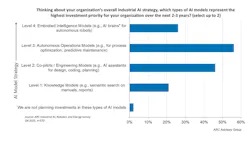
ARC's Industrial Artificial Intelligence Survey, conducted in fourth quarter 2025 with 570 respondents, found that about 55% were looking to invest in autonomous operations AI models within the next two to three years.
Organizations that have not yet begun should define a phased path from co-pilots to agentic AI. Co-pilots and AI assistants are already common additions to connected worker solutions, responding to requests such as finding documents, summarizing equipment histories, and drafting instructions.
An AI agent goes further by pursuing a defined objective across multiple steps. In a connected worker environment, an agent might detect an incomplete inspection, check for related open work, notify a supervisor, and draft a follow-up work request.
See also: Study sees AI 'maturity gap,' finds companies lack capacity to implement agents
AI agents offer a practical path to staged, bounded autonomy. At each stage, manufacturers should define permitted data sources and actions, confidence thresholds, and approval requirements. This discipline becomes especially important as connected worker pilots expand across sites.
Agents can help coordinate repeatable workflows, apply common decision logic, and connect frontline actions with enterprise systems, but only when they operate within a consistent governance framework.
A well-designed agentic architecture can reduce the need to recreate every workflow locally while still allowing controlled configuration for site-specific assets, processes, and requirements. Planning for these capabilities early helps manufacturers avoid scaling disconnected pilots that later demand costly redesign and integration.
The real destination: Connected, governed work
The destination is not simply broader deployment of connected worker tools. It is a connected, governed operating model that improves how work is executed across the enterprise.
Across this three-part series, the central lesson has been consistent: sustainable value begins with a clearly defined operational problem, depends on trusted data and context, and requires the architecture, governance, integration, and frontline engagement needed to turn technology into repeatable results.
See also: Industrial IoT starts with the physical layer: Rethinking cables, conductors and connectivity
The scaling imperative is therefore not simply to extend a successful pilot, but to make each deployment easier to repeat, govern, and adapt than the one before it. Done well, connected worker technology becomes part of the enterprise’s operational fabric, strengthening execution across sites while creating a practical path toward more autonomous ways of working.
About the Author
 Inderpreet Shoker
Inderpreet Shoker
Inderpreet Shoker performs research for ARC Advisory Group and consults with clients in the areas of asset performance management, asset integrity management, plant asset management, and asset reliability. She also leads the research on augmented reality and other extended reality technologies at ARC.