From labs to factories: Physical AI’s growth expected to explode
What you’ll learn:
- Physical AI is the term used to describe systems that don't just recommend a decision but execute it—on a conveyor, an assembly cell, in a warehouse.
- The pace of announcements from robotics and chip vendors over the past year has been unusually dense.
- For capital allocators, the physical AI category sits at an unusual intersection of semiconductor demand, industrial robotics, and enterprise software.
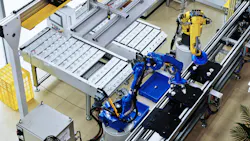
For most of the last decade, AI on the plant floor meant something narrow; a vision system spotting a scratched panel, a predictive model flagging a bearing before it failed. Useful, but confined to screens and dashboards, watching rather than doing.
That confinement is ending. Physical AI—the fusion of large-scale machine learning with robots, machines, and sensors that act directly on the physical world—is now the term manufacturers, investors, and automation vendors use to describe systems that don't just recommend a decision but execute it—on a conveyor, an assembly cell, in a warehouse.
See also: Has physical AI gone ‘mainstream’? One new survey says yes
The shift shows up in the numbers as much as in the demos. According to Acumen Research and Consulting, the global physical AI market size accounted for over $5 billion in 2025 but is estimated to achieve a market size of $82.8 billion in a decade, by 2035, a projected compound annual growth rate of 32.8%.
That is not incremental automation spending. It’s a market being built almost from scratch around a new category of machine intelligence, one that plugs directly into the themes readers of Smart Industry already track closely: digital transformation, IIoT platforms, industrial cybersecurity, and the automation stack that ties them together.
Recent breakthroughs worth watching
The pace of announcements from robotics and chip vendors over the past year has been unusually dense.
At Nvidia's GTC event in March, the company introduced Isaac GR00T N models and Cosmos world models built to give robots a general sense of physics and cause and effect, rather than task-specific scripts. Industrial names such as ABB Robotics, FANUC, KUKA, Yaskawa, Universal Robots, and Agility Robotics are building on that same simulation-to-deployment pipeline.
Here are some selected physical AI ecosystem partners and their primary industrial focus:
- FANUC, KUKA, Yaskawa, ABB Robotics: Industrial arms and factory automation retrofits
- Figure AI, Agility Robotics, Boston Dynamics: Humanoid and bipedal robots for logistics and assembly
- Universal Robots: Collaborative robots (cobots) for small and midsize manufacturers
- Skild AI, World Labs: Foundation models for robot reasoning and perception
- Techman Robot: Industrial humanoid systems (unveiled at GTC 2026)
Private and public money making the same bet
What's unusual about this cycle isn't just the size of the checks being written, it's that venture investors and governments are pouring capital into the exact same category at the exact same time, often into the same companies.
See also: What to do when ‘rip-and-replace’ is financially impossible
On the private side, the numbers have gotten hard to ignore:
- Skild AI, which is building what it calls a general-purpose “brain” that can operate different robot bodies without retraining, closed a $1.4 billion round in January that pushed its valuation to $14 billion, roughly tripling in seven months.
- NEURA Robotics, a German humanoid maker whose platforms already run inside Volkswagen and Deutsche Post facilities, followed two months later with a $1.2 billion Series C, the largest single fundraise by a European robotics company.
- Figure AI has raised close to $1.9 billion in total at a $39 billion valuation, and its BotQ facility is reportedly turning out a finished humanoid roughly every 90 minutes.
Meanwhile governments outside the U.S. (we'll deal with America in a moment) aren't sitting on the sidelines watching this happen:
- South Korea's finance and industry ministries announced roughly $10.3 billion in policy financing for 2026 under a program called M.AX Frontier, aimed squarely at getting physical AI into factories, vehicles, and defense manufacturing, with a separate goal of turning the country into a leading producer of industrial and humanoid robots by 2030.
- Japan's government has committed to a combined public-private figure of around 10.5 trillion yen, close to $70 billion, in the physical AI sector through 2040.
- China's 15th Five-Year Plan puts robotics at the center of its industrial policy, building on a manufacturing base that already runs roughly 2 million industrial robots, about 4.5 times what Japan operates, and that already accounts for over half of all industrial robots installed worldwide in a given year.
What this means for investors and stakeholders
For capital allocators, the physical AI category sits at an unusual intersection of semiconductor demand, industrial robotics, and enterprise software, which makes it hard to size using a single comparable.
Investors evaluating this space should watch deployment timelines and unit economics as closely as headline funding rounds. A humanoid or mobile manipulator that pays back its cost in 18 to 24 months on a single shift is a fundamentally different investment case than one requiring multiyear integration projects.
See also: Growth in IoT sensor market points toward strong momentum for DX
If you want to see where physical AI stops being a bet on the future and starts being a matter of survival, look at Japan.
The Japanese physical AI market size was valued at $307 million in 2025 and is expected to reach around $6.8 billion by 2035, expanding at a CAGR of 36.2% in that time.
That growth rate outpaces the global average by a wide margin, and it puts Japan on track to be the fastest-growing physical AI market anywhere in the world over the coming decade.
That trajectory is not accidental. Japan's Ministry of Economy, Trade and Industry has spent years funding robotics research through its Society 5.0 initiative, and the Asian nation’s demographic reality—a shrinking working-age population and one of the highest ratios of industrial robots per manufacturing worker in the world—has made physical AI less an experiment and more a structural necessity.
If you want to see where physical AI stops being a bet on the future and starts being a matter of survival, look at Japan.
The robotics divisions of Japanese industrial giants such as Fanuc, Yaskawa Electric, Kawasaki Heavy Industries, and Toyota rank among the most active global partners in humanoid and foundation-model robotics programs, while SoftBank's continued investment in AI infrastructure gives the country a compute base to support model training at scale.
This is Japan’s physical AI market size and valuation—actual since 2023 and estimated out a decade to 2035—that every investor should know:
- 2023: $121.6 million
- 2024: $193.6 million
- 2025: $307.3 million
- 2026: $420.4 million
- 2027: $574.7 million
- 2028: $784.7 million
- 2029: $1.07 billion
- 2030: $1.46 billion
- 2031: $1.99 billion
- 2032: $2.7 billion
- 2033: $3.7 billion
- 2034: $5 billion
- 2035: $6.8 billion
The U.S. physical AI market: What to expect
The growth of the U.S. physical AI market tells a different kind of growth story than Japan's. And it's worth being precise about the difference rather than folding it into the same "boom" narrative.
According to Acumen, America’s physical AI market size was valued at about $2.3 billion in 2025 while estimates see it reaching $27.3 billion by 2035. The U.S. market is growing at a CAGR of 31.7% during the forecast period of 2026 to 2035.
See also: Rockwell, Augury debut maintenance, industrial performance team-up
What the U.S. figures show is scale. And that, in 2025, the American market already accounted for a significant share of global physical AI spending that year. Run the math forward to 2035 and the U.S. won't lose ground so much as grow at a normal, sustainable pace while younger markets catch up.
That scale shows up in the details of actual deployments, not just projections:
- Figure AI's humanoid robots spent 11 months on BMW's production line in Spartanburg, South Carolina, logging around 1,250 operating hours and loading more than 90,000 sheet metal components while helping build over 30,000 BMW X3 vehicles, work precise enough to place parts within roughly 5 millimeters of tolerance.
- BMW has since brought in an upgraded unit for a different task, sorting components into sequencing trolleys for just-in-time delivery to the line.
- A few states over, Amazon's majority-owned Agility Robotics has its Digit units moving totes inside a GXO-operated Spanx fulfillment center in Georgia, which has passed 100,000 totes handled under a robots-as-a-service arrangement.
On the other hand, U.S. public policy has backed this activity in ways that go beyond any single robotics line item.
The Biden-era CHIPS and Science Act put roughly $52.7 billion behind domestic semiconductor research and manufacturing, and this year the U.S. Department of Commerce issued letters of intent worth $874 million to seven companies developing the advanced packaging and compute technology that AI-driven robotics ultimately depends on.
Deployments at BMW, Amazon, Toyota, and Mercedes-Benz plants in the U.S. are producing the operating data that will decide which platforms earn a permanent place on the factory floor and which, frankly, don't.
For investors and stakeholders tracking physical AI from a manufacturing or investment seat in the U.S., that steadiness is precisely why it deserves ongoing attention. The deployments at BMW, Amazon, Toyota, and Mercedes-Benz plants are producing the operating data that will decide which platforms earn a permanent place on the factory floor and which, frankly, don't.
'Clean' data, robust cyber defenses, IT-OT convergence cannot be minimized
None of the private and public investment in physical AI and the breakthroughs in adoption this technology has made replaces the fundamentals that this publication often covers: cybersecurity for newly connected OT systems, IT and OT convergence, and the unglamorous work of getting sensor data clean enough for AI and other digital systems to trust.
See also: AI in manufacturing won’t deliver until supplier ecosystems are connected
If anything, physical AI raises the stakes on all three.
A robot that can reason and act autonomously is also a new attack surface if its training data or connectivity is compromised. And no kind of AI does much good if the data foundation it operates from is fragmented or incomplete.
About the Author
 Mahima Sambre
Mahima Sambre
Mahima Sambre, a trained business journalist, is a market research writer and insights expert for Acumen Research and Consulting. She specializes in emerging technologies, industrial automation, artificial intelligence, robotics, and advanced manufacturing. She’s analyzing the rise of physical AI, tracking automation trends, or exploring the next wave of smart manufacturing.