Report: Growth in IoT sensor market points toward strong momentum for DX
What you’ll learn:
- The IoT sensor market is set to have a compound annual growth rate of 37.6% to 2035.
- The market is set to grow from around $24 billion in 2025 to $549 billion in 10 years.
- Advancements in cloud computing, edge analytics, and AI are further enhancing the functionality and scalability of IoT sensor networks.
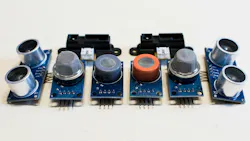
As I blog from the beach while on a little working vacation, I ran across a report that seems to yield some pretty strong indications of the momentum of digital transformation: that the IoT sensor market is set to have an enormous compound annual growth rate of 37.6%.
Remember that IoT is any network of physical objects embedded with sensors, software, and connectivity, allowing them to collect and exchange data for all sorts of purposes, including to feed AI-assisted services such as predictive maintenance.
See also: For sweeter AI adoption, Hershey and KDP utilize Augmentir's connected worker platform
Speaking of data: The data on the growth of the sensor market comes courtesy of an analysis put out last month from Global Market Insights, and it sees impressive dollar numbers behind the surge—to the tune of the 37.6% CAGR and from around $24 billion in 2025 to reach about $549 billion in 10 short years, by 2035.
According to GMI, the IoT sensors market is witnessing exponential growth driven by the rapid acceleration of digital transformation across industries and the widespread integration of connected technologies. That’s all about Industry 4.0 adoption.
GMI also notes that public infrastructure is driving the growth, that expanding smart projects are boosting sensor deployment across transportation, utilities, and public safety systems. “The growing use of predictive maintenance solutions is enabling enterprises to reduce operational downtime and improve asset efficiency,” according to GMI.
“The continuous increase in connected devices globally is reinforcing the importance of IoT sensors as a core enabling technology for real-time data collection, automation, and intelligent decision-making across industrial, commercial, and public sectors.”
Also: “Advancements in cloud computing, edge analytics, and artificial intelligence are further enhancing the functionality and scalability of IoT sensor networks, supporting their integration into complex digital ecosystems.”
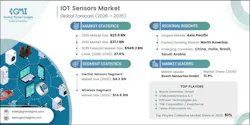
The GMI report also breaks down the market growth by the kinds of sensors, including:
- Inertial, including accelerometers, gyroscopes, and magnetometers that are widely used across consumer electronics, industrial systems, automotive platforms, wearables, and drones.
- Wireless, supported by the rapid expansion of smart homes, industrial IoT ecosystems, connected healthcare devices, smart infrastructure projects, and wearables. Increasing deployment of connectivity tech such as Wi-Fi, Bluetooth Low Energy, Zigbee, LoRaWAN, NB-IoT, and 5G is accelerating adoption across multiple application areas, GMI noted.
North America occupies a quarter of the IoT sensor market
North America IoT sensors market held 25.5% share in 2025, driven by early adoption of industrial automation technologies and strong implementation of IoT-enabled solutions across key industries, according to Global Market Insights.
See also: AI stokes debate over cloud-powered compute vs. on-prem
North America has benefitted from significant investments in smart infrastructure and digital transformation initiatives across manufacturing, health care, transportation, and utilities. A healthy ecosystem of semiconductor manufacturers, technology providers, and cloud service companies is further supporting regional growth and accelerating the adoption of advanced sensing technologies, GMI reported.
GMI also noted the major players in the IoT sensor market, including STMicroelectronics N.V.; Bosch Sensortec; Texas Instruments; Infineon Technologies; Analog Devices; Murata Manufacturing; TDK Corp./InvenSense; ROHM; Sensirion; Melexis, Vishay Intertechnology; Panasonic; PixArt Imaging; Seiko Epson Corp.; and MEMSIC Semiconductor.
About the Author
 Scott Achelpohl
Scott Achelpohl
Head of Content
I've come to Smart Industry after stints in business-to-business journalism covering U.S. trucking and transportation for FleetOwner, a sister website and magazine of SI’s at Endeavor Business Media, and branches of the U.S. military for Navy League of the United States. I'm a graduate of the University of Kansas and the William Allen White School of Journalism with many years of media experience inside and outside B2B journalism. I'm a wordsmith by nature, and I edit Smart Industry and report and write all kinds of news and interactive media on the digital transformation of manufacturing.