For sweeter AI adoption, Hershey and KDP utilize Augmentir's connected worker platform
What you'll learn:
- Hershey and Keurig Dr Pepper are both using an AI-powered connected worker platform by Augmentir to improve workforce performance by collecting data on how employees perform tasks and generating insights for training, quality, maintenance, and operational efficiency.
- "Augie" analyzes task completion times, engagement levels, shift performance, and maintenance activities, helping these companies and others like Duracell and Andersen Windows address labor shortages, skills gaps, downtime, and quality issues.
- At KDP, the platform reduced product-changeover errors by using OCR and AI to verify can barcodes and product matches.
As manufacturers continue to implement AI agents across many settings, some are using a connected worker platform to tailor these agents to their individual workforce needs. Candy and soda icons Hershey and Keurig Dr Pepper are two prime examples.
Industrywide, AI is being adopted by manufacturers at larger scale, as physical (the kind that helps operate robots, vehicles, and machinery in real-time) and agentic AI become increasingly useful—perhaps even necessary—for many factory operations.
However, it’s not uncommon for manufacturers to experience high failure rates when integrating these virtual agents.
One report, for example, found that manufacturers across industry verticals are split on AI's impact in industry, although they agreed on its lofty overall potential as companies continue to embrace the much-ballyhooed technology and move beyond pilots and into production-based deployment.
In other words, for some companies, the transition has been sweeter than others.
The Hershey Co., maker of more than 90 brands of sweets and snacks, including their famous chocolate bars and Kisses, is among the makers driving digital transformation in its candy factories, using AI to augment its workforce through various platforms.



Another, Keurig Dr Pepper, manufacturer of the iconic Keurig single-serve coffee pods as well as more than 125 beverage brands, uses the same AI platform as a pilot for product changeover.
Hershey is using an AI-powered connected-worker platform created by Philadelphia-based Augmentir to drive workforce transformation in its factories.
Both companies are presenting a wide variety of use cases.
As manufacturing companies across verticals are navigating how to implement AI into their workforce processes, Augmentir’s platform, called “Augie,” aims to allow companies to tailor the tech to their own needs.
“There's been a lot of advancements in digital transformation of equipment, machines, and making machines smart and connected, but little in terms of making humans smart and connected,” said Chris Kuntz, chief marketing officer of Augmentir.
“So, we said, ‘What we want to do is build a platform that empowers humans to do work better.’”
Kuntz said that Augmentir’s agentic AI platform is designed for use in workforce and factory settings, working alongside human workers while capturing data on how workers perform. Other players in the software space—Siemens and IFS among them—have entered the marketplace with similar agentic products.
Augmentir's platform is workforce-intensive
Part of the reason why Augmentir's platform was created was in response to workforce data problems, such as how work was being measured anecdotally, Kuntz said.
See also: Robotics isn’t having its ChatGPT moment just yet
The need for better data on worker behavior only increased as issues like labor shortages, aging workforces and skills and labor gaps became more prominent in the manufacturing industry. This creates problems like increased machine downtime and quality, and production issues.
“If you can understand the workers correctly, you can provide intelligent guidance and support for those workers,” he said.
There's been a lot of advancements in digital transformation of equipment, machines, and making machines smart and connected, but little in terms of making humans smart and connected. So, we said, ‘What we want to do is build a platform that empowers humans to do work better.’
- Chris Kuntz, chief marketing officer, Augmentir
The platform captures signals, such as how long workers take to perform certain tasks like machine maintenance and worker engagement rates on assembly lines, and then crafts insights on worker performance based on those signals for customers to use.
Insights can include shift performance data; previous shift hand-off information; and maintenance request tools, among others.
See also: Why industrial AI requires a data ops foundation to scale
Kuntz emphasized that Augmentir prioritized data collection from human workers. Data collection for AI agents has been a continuous challenge for manufacturers when implementing agents, as many struggle with effective and continuous data collection, especially with human workforces.
“In any case, everyone's using the AI aspects of it, meaning they're collecting data on how the workers are performing and surfacing insights that they can act on,” Kuntz said.
KDP's immediate need: barcodes
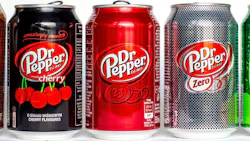
In the case of Keurig Dr Pepper, that company used the platform for product changeover. When changing aluminum cans for different products, such as from regular Dr Pepper to Diet Dr Pepper, the company dealt with issues of waste and potential product recalls due to barcodes on the aluminum cans.
The barcodes are often in different positions on cans and are sometimes faded, so operators have to read barcodes and make sure it matches up with the filler liquid coming up to fill the cans, unable to use computer vision systems due to the variability in the cans and machines.
Human errors have resulted in product recalls due to incorrect product changeover. Last year, over 19,000 cases of Dr Pepper Zero Sugar were recalled, as 12-ounce cans labeled as zero sugar were found to contain the full sugar of regular Dr Pepper.
The company did a three-month pilot with Augmentir last year, putting Augie in the middle of that process. Augie took a picture of the can and performed optical character recognition to make sure the codes matched and the correct liquid was put into the correct can.
Therefore, human errors that can occur when matching codes are avoided. It then tells the machine operator to continue with product changeover.
See also: Integrating IT, OT, and AI for real-world competitiveness
KDP embarked about two years ago on a network-modernization journey. The company has implemented a wide range of manufacturing technologies, including a manufacturing execution system, live performance metrics dashboards, machine learning, and predictive maintenance.
Myriad use cases at Hershey
Kuntz said one of the uses at Hershey of the connected worker platform included providing corrective action insights for problems on the factory floor.
The company also used quality agents and training agents to identify where workers needed additional guidance and training. It also used agents to schedule machine maintenance routines and the starting and stopping of production lines.
If you can understand the workers correctly, you can provide intelligent guidance and support for those workers.
- Chris Kuntz
Augmentir also has “why” agents, which are root cause analysis agents that are acting on various data that feeds into the platform for workers to have access to when they use Augie.
Use cases often center around equipment operation, maintenance on equipment, quality, safety and workforce development or training, among others, Kuntz said.
Other Augmentir customers include Biochem Fluidics, Hunter Industries, Duracell, and Andersen Windows.
About the Author
 Sarah Mattalian
Sarah Mattalian
Staff Writer
Sarah Mattalian is a Chicago-based journalist writing for Smart Industry and Automation World, two brands of Endeavor Business Media, covering industry trends and manufacturing technology. In 2025, she graduated with a master's degree in journalism from Northwestern University's Medill School of Journalism, specializing in health, environment and science reporting. She does freelance work as well, covering public health and the environment in Chicagoland and in the Midwest. Her work has appeared in Inside Climate News, Inside Washington Publishers, NBC4 in Washington, D.C., The Durango Herald and North Jersey Daily News. She has a translation certificate in Spanish.