Report: Manufacturers split on whether to prioritize industrial AI
What you'll learn:
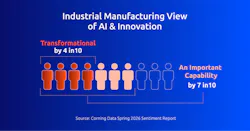
- According to Corning Data's report, manufacturers are divided on AI’s impact, as 43% view industrial AI as transformational, while most see it as important but not yet essential.
- Efficiency is the top driver for investment as two-thirds of respondents cited productivity and operational efficiency as the main reasons for increasing AI spending.
- The report found that AI initiatives work best when driven by cross-functional teams, while costs, governance, and organizational change remain major barriers to progress.

Manufacturers across industry verticals are split on the impact of AI in industrial manufacturing but agree on its overall potential as companies continue to embrace the technology and move into production-based deployment, according to one report.
Over 40% of participants described the impact of AI as “transformational,” while 57% were segmented between viewing it as important but not seeing the technology as a primary growth driver (29%), a strategy to avoid falling behind (15%), or experimental (9%).
See also: Physical AI in manufacturing: Assistant, replacement or something in between?
The findings emerge from an IT consulting and managed services firm, Corning Data, and its 2026 Sentiment Report, which surveyed more than 250 manufacturers across the U.S., with two Canadian-based sources who work throughout North America included in the written report.
Statistics from the National Association of Manufacturers support Corning Data's findings, as 40% of NAM members believe in the potential of AI now as opposed to 10% just two years ago in 2024.
Motivations for adopting these tools shift
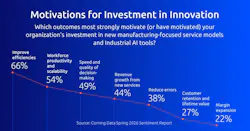
The report from Corning Data, which provides 24/7 helpdesk and implementation and upgrade support for ERP software, also found that 66% of its respondents rated improved efficiency as the most compelling rationale for additional investment in industrial AI, ranking efficiency and revenue as being among the primary motivators for investment in new manufacturing-focused service models and AI tools.
However, the report also found that almost 60% of respondents do not view industrial AI as essential to their businesses.
This could be due to a number of factors. The Corning Data report was released this month as manufacturers face challenges such as supply chain uncertainties, turmoil wrought by Donald Trump's tariffs, and increased rates of cyberattacks in the manufacturing industry.
Additionally, manufacturing companies also face high risks of failure when adopting AI agents.
See also: Survey: AI adoption continues apace, despite uncertainties and failure risk
In terms of what the report found, a common theme it identified was that AI projects are more likely to fail when they are treated strictly as IT initiatives.
And in terms of supply chain challenges, supply chain impact and speed of decision-making rated the highest of seven “warning signs” of extinction, although were all rated a moderate risk with a score over 3.3.
Views of AI differ among job functions, roles
The report also found that the view of industrial AI’s importance varies according to job functions and roles.
For example, 54% of C-suiters identified industrial AI as transformational, which was mirrored by IT roles (54%) and leadership (50%). However, only 37% of respondents who worked in operations felt the same, followed by 23% employed in finance functions.
Therefore, proper governance requires a cross-functional "middle-in" approach involving the C-suite, business owners, and end users, the Corning Data report concluded.
This style of governance has already been used effectively by some companies, as one expert in the semiconductor manufacturing space advised that communication between company departments was the key to successfully deploying AI agents.
See also: Stories of AI adoption: Wolfspeed all-in with 22 agents across key company teams
Cost is an additional factor in determining how companies are willing to prioritize innovating with AI. The Corning Data report found that costs, funding prioritization and the willingness to change operating models are the issues most likely to stall progress and long-term success.
More than 80% of manufacturers in the Corning Data research said they budget 1% to 2.5% of sales revenue for innovation, which falls within industry standards that show mature manufacturing firms typically budget from 1% to 3% of revenue toward innovation; for this survey, 84% spend at least 1%.
See also: AI is exposing a massive data problem in the supply chain
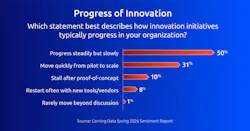
Timing also is a factor. About 80% of participants said initiatives are making progress, but half said progress is slow but steady.
Nearly 80% have a time horizon that ranges between three and 12 months, with a significant number determining effectiveness within three to six months. However, smaller companies expressed greater urgency, as small industrial manufacturing firms, including start-ups, are more likely to have more narrow timelines and financial constraints for their business and innovation plans, the report found.
In terms of what motivated manufacturers to adopt AI, over 50% of participants said that efficiency and productivity, followed by decision-making speed and quality, are the greatest motivating factors.
“When they work as intended, innovation and technology drive solutions, solve problems and create opportunities in business,” said John Walczak, chief architect of Corning Data.
“But it doesn’t happen magically overnight. Finding solutions requires planning, commitment, patience, and flexibility.”
About the Author
 Sarah Mattalian
Sarah Mattalian
Staff Writer
Sarah Mattalian is a Chicago-based journalist writing for Smart Industry and Automation World, two brands of Endeavor Business Media, covering industry trends and manufacturing technology. In 2025, she graduated with a master's degree in journalism from Northwestern University's Medill School of Journalism, specializing in health, environment and science reporting. She does freelance work as well, covering public health and the environment in Chicagoland and in the Midwest. Her work has appeared in Inside Climate News, Inside Washington Publishers, NBC4 in Washington, D.C., The Durango Herald and North Jersey Daily News. She has a translation certificate in Spanish.