Robotics isn’t having its ChatGPT moment just yet
What you’ll learn:
- The leap from large language models to intelligent robots is not as direct as the recent enthusiasm suggests.
- Building robust robots is arguably a harder problem to solve than autonomous driving.
- If the U.S. is serious about bringing manufacturing back home, it must address the robotics data problem.
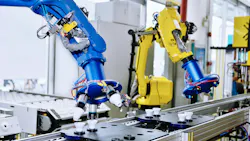
When NVIDIA CEO Jensen Huang speaks, the tech world listens. In recent months, he’s declared “the ChatGPT moment for robotics is here” and “every industrial company will become a robotics company.”
Progress is real, but the leap from large language models to intelligent robots is not as direct as the recent enthusiasm suggests. In my more than 25 years investing in deep tech, including autonomous vehicle software and AI networking infrastructure, robotics has rarely risen to the top of my priorities.
See also: Future of manufacturing still depends on human judgment
There’s a stubborn gap between large language models and the data used to train robots. LLMs work because they’ve been trained on the entire internet. Capturing enough real-world demonstration data to build intelligent robots is not trivial.
Today’s robots are typically trained on Vision-Language-Action models, or VLAs. The system watches thousands of demonstrations and learns to replicate what it sees. Show it enough examples, and it maps images to actions. It’s expensive, slow, and sparse. You can’t scrape reality like you can scrape text. That’s why most robots perform well in a lab, but struggle in the real world.
Waymo was an early blueprint
The industry has been here before. Consider Waymo. Autonomous driving once seemed straightforward: drive enough miles, cover enough scenarios, and the model will converge. And it did, up to a point.
The first 90% of the capability came relatively quickly. The final 10% follows a long tail: the closer you get to full capability, the harder and more expensive each step becomes. Many concluded that if they could just keep collecting data, convergence would come.
Blog: Manufacturing tech companies showcase big themes, trends at Automate 2026
Today, many robotics companies appear to be walking the same path. The process often begins with humans outfitted with sensors to capture as much motion data as possible, which is then fed into a model. This approach will take years, if not decades, before robots can move reliably and autonomously.
LLMs work because they’ve been trained on the entire internet. Capturing enough real-world demonstration data to build intelligent robots is not trivial.
Building robust robots is arguably a harder problem to solve than autonomous driving. Driving typically involves a limited set of actions at any moment. Robotics features a combinatorial explosion: countless possible movements, continuous environmental change, and constant reassessment. The architecture is fundamentally bottlenecked by the data it depends on.
10 hours vs. 100,000 hours
There may be a better starting point hiding in plain sight: internet video.
It’s the only dataset that approaches internet scale while capturing how the physical world actually behaves—how objects move, interact, fall, and recover.
Humanity has accumulated the physics of reality across hundreds of millions of videos. There are companies doing this now and seeing results on 10 hours of demonstrations, rather than the 100,000 hours needed by VLAs.
Generality across AI has unlocked a consistent pattern: pretrain on internet-scale data and then fine-tune on task-specific data. We did it with language. We did it with images. Robotics has yet to apply this lesson—not because the idea’s flawed, but because translating video prediction into real-time action remains an unsolved engineering problem.
If the U.S. is serious about bringing manufacturing back home, it must address the robotics data problem. Otherwise, reshoring efforts are wishful thinking.
This shift in thinking is subtle but important. Instead of mapping what a robot sees directly to what it does (the “see-and-do” architecture of VLAs), you should train a model to foresee what should happen next in real time: observe, predict, act, and adapt to various conditions.
This reframes the data problem. A model pretrained on internet video already understands motion and physical interaction at scale. Task-specific fine-tuning becomes a fraction of what VLAs require, shifting the bottleneck from data collection to a harder question: Can the model generalize to the messy, variable conditions of real production environments?
Whitepaper: IT-OT convergence successes and failures
Early evidence suggests it can, and the implications extend far beyond venture returns.
If the U.S. is serious about bringing manufacturing back home, it must address the robotics data problem. Otherwise, reshoring efforts are wishful thinking. The labor shortage in industrial manufacturing is real and deepening: nearly 2 million jobs could go unfilled by 2030. Automation is structurally necessary.
The excitement around physical AI is real. So is the hard problem underneath it.
Robotics may not be waiting for a breakthrough moment. It may be waiting for a change in how we teach machines to learn from the world around us.
About the Author
 Sandesh Patnam
Sandesh Patnam
Sandesh Patnam is managing partner at Premji Invest, a $16 billion evergreen crossover fund headquartered in India but with offices in Menlo Park, California.
He has spent the last 25 years investing in “deep tech”—including autonomous-vehicle software and AI networking infrastructure, enterprise, consumer, health, and financial technology—and evaluating the underlying architecture and commercial viability of emerging hardware systems.
Premji's capital also supports the Azim Premji Foundation—one of the world's largest philanthropic endowments.