Blog: Manufacturing tech companies showcase big themes, trends at Automate 2026
What you'll learn:
- AI drove many Automate 2026 exhibits, with companies showcasing tools to simplify automation and AI adoption.
- Flexibility was a focus, as firms like Universal Robots demonstrated AI-powered robotics that can be tested and scaled in real-world environments.
- Connectivity remained critical, with Ericsson highlighting how private 5G networks support AI applications, predictive maintenance, and industrial IoT.
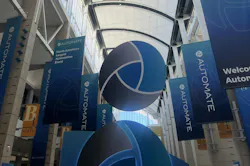
Companies showcased at Automate 2026 manufacturing technology that closely aligns with industry trends this year.
At the show, which took place from June 22 to June 25 in Chicago, many companies focused on key themes such as software-defined automation with an emphasis on AI development, connectivity, and flexibility of technology and AI uses.
See also: Industrial AI has transitioned to the ‘application phase’
Needless to say, AI was present everywhere, as companies showcased how they are using agents and platforms to augment their connectivity and flexibility.
Physical AI and connectivity
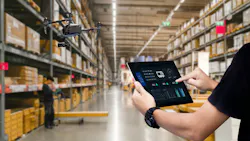
Telecommunications leader Ericsson showcased how the shift to physical AI benefits them from a connectivity perspective.
5G solutions, the company said, are integral for manufacturers' digital transformation, particularly in how private 5G networks can optimally connect workers, machines, and data while improving efficiency.
See also: From servers to outcomes: The Software-as-a-Service shift transforming industrial reliability
For example, the company said that their AI-powered predictive maintenance with 5G, which has an additional prescriptive mode, can reduce downtime while enabling sensors to be installed in more challenging locations, continuously communicating real-time data.
According to Ericsson, having a unified connectivity platform that integrates manufacturing companies’ existing digital assets can better enable new technologies. 5G connectivity, company officials said, helps achieve this by delivering scalable and flexible solutions that can harness large amounts of data generated by industrial IoT devices.

Software automation and AI development
Most companies on-site either showed how their products help navigate AI implementation into a company’s processes and products or help adopting organizations develop use cases.
For example, Beckhoff announced its TwinCAT CoAgent, an AI-based digital assistant that the company defined as an “open, model-independent AI assistance for automation programming and controls engineering.”
TwinCAT CoAgent is an open system, meaning that the user can choose which large language model to use with the product.
The agent aims to support engineers throughout the automation lifecycle, combining generative AI with specialized agents.
See also: Stories of AI adoption: Wolfspeed uses ‘three-stage maturity model’ for agent deployment
According to Beckhoff, TwinCAT CoAgent aims to address industry challenges such as shorter development cycles, higher quality requirements, and skilled worker shortages.
The agent aims to automate routine tasks, allowing engineers to focus on demanding automation while less experienced personnel can achieve results faster through guidance.
Other companies, such as Universal Robots and telecommunications company Ericsson, are also implementing AI into their systems to promote other themes of connectivity and flexibility.
Flexibility to develop AI models
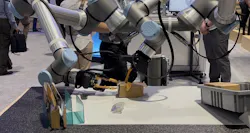
Universal Robots, a manufacturer that specializes in AI-powered collaborative robots, is focusing on AI with physical, real-world operations. UR serves as the platform for other companies to develop their AI models, providing a production-grade setting where companies can test their AI, including in humanoids.
See also: Intelligent robots are bridging the gap from automation to autonomy
According to UR, this allows companies to expose models early to variability and physical interaction to help reveal issues before deployment.
According to the company, this helps with scalability, speed, and reduced downtime, ultimately improving the flexibility of AI applications.
Alongside Mobile Industrial Robots, the company showcased live demonstrations of robots that they said can have the following benefits and applications:
- Smart depalletizing with AI Vision
- Vision-guided precision assembly
- AI-driven inspection
- Intelligent unstructured picking
- Flexible machine tending
- Real-time force-controlled polishing
- Autonomous mobile robots enabling dynamic material movement
The company has more than 1,200 partners globally, including technology and OEM solution partners in order to provide secure foundations for AI robotics.
The company has safety built into every deployment and also supports replication of models and technologies across factories. It said this aims to reduce deployment risk and shorten the time between pilot phases and rollouts.
About the Author
 Sarah Mattalian
Sarah Mattalian
Staff Writer
Sarah Mattalian is a Chicago-based journalist writing for Smart Industry and Automation World, two brands of Endeavor Business Media, covering industry trends and manufacturing technology. In 2025, she graduated with a master's degree in journalism from Northwestern University's Medill School of Journalism, specializing in health, environment and science reporting. She does freelance work as well, covering public health and the environment in Chicagoland and in the Midwest. Her work has appeared in Inside Climate News, Inside Washington Publishers, NBC4 in Washington, D.C., The Durango Herald and North Jersey Daily News. She has a translation certificate in Spanish.