Future of manufacturing still depends on human judgment
What you’ll learn:
- AI can reduce friction, but don’t let it reduce thinking.
- The risk is no longer simply human error. It is passive acceptance, assuming AI outputs are correct.
- Many manufacturers say AI adoption success depends heavily on frontline leadership readiness and workforce adaptability.
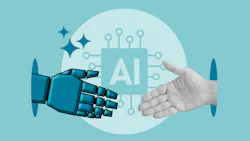
For years, the conversation around AI in manufacturing has centered on automation: faster production lines, smarter maintenance schedules, optimized supply chains, and increasingly autonomous systems capable of making decisions in real time.
But as manufacturers push deeper into AI-enabled operations, a different challenge is starting to emerge, one that has less to do with the technology itself and more to do with the humans responsible for overseeing it.
See also: Autonomy is a journey, not a switch to be turned on and off
The future of manufacturing will not be defined by removing humans from the process entirely. Instead, it will depend on how effectively organizations prepare workers and leaders to supervise, validate, and challenge increasingly autonomous systems.
In many industrial environments, the role of the worker is beginning to shift from “human in the loop” to “human on the loop.”
Historically, operators and managers were directly involved in executing processes and making operational decisions themselves. Now, AI systems are increasingly capable of handling portions of that execution autonomously, leaving humans responsible for oversight, intervention, and accountability when things go wrong.
The biggest risk isn’t AI failure—it’s passive acceptance
As AI takes on greater operational responsibility, manufacturing leaders face a new type of complexity: knowing when to trust the system, when to intervene, and how to identify subtle failures that may not be immediately obvious.
In highly automated environments, the risk is no longer simply human error. It is passive acceptance, assuming AI outputs are correct because they were generated by sophisticated systems. AI can reduce friction, but don’t let it reduce thinking.
The risk is mistaking speed for progress. AI makes it easy to produce outputs quickly, but faster outputs don't automatically lead to better outcomes. Many AI systems provide outputs without explainability or confidence signals. This is where human judgment becomes indispensable.
Manufacturing environments are dynamic, unpredictable, and shaped by variables AI models cannot fully contextualize. Equipment conditions change. Suppliers introduce inconsistencies. Safety concerns evolve in real time. Operational priorities shift suddenly due to labor shortages, weather disruptions, or geopolitical pressures.
Whitepaper: IT-OT convergence successes and failures
AI can help organizations respond faster to these challenges, but it can’t replace the contextual awareness and decision-making instincts that experienced workers bring to the floor.
Why manufacturers need workers who can challenge AI
The organizations seeing the most value from AI are not treating it as an autonomous replacement for human expertise. They are treating it as a thought partner, a system designed to augment human thinking rather than bypass it. That requires a fundamentally different workforce mindset than many manufacturers have traditionally prioritized.
For decades, industrial workforce development focused heavily on technical execution: operating machinery, following procedures, maintaining systems, and reducing process variability. Those capabilities remain essential, but they are no longer sufficient on their own.
The manufacturers that succeed in the next phase of industrial AI adoption will likely be the ones that recognize workforce readiness as equally important as the technology itself.
As AI adoption accelerates, manufacturers increasingly need workers who can evaluate AI-generated recommendations, recognize flawed outputs, ask better questions, and make judgment calls in ambiguous situations.
Manufacturing automation has primarily been focused on automating routing tasks. With AI, the opportunity for automaton extends beyond the routine, increasing impact but also potential risk.
See also: Industrial AI has transitioned to the ‘application phase’
Many manufacturers say AI adoption success now depends heavily on frontline leadership readiness and workforce adaptability, highlighting that operational transformation is becoming as much a people challenge as a technology one.
In practice, this means power skills—critical thinking, curiosity, communication, risk awareness, adaptability, and decision-making—are becoming operational capabilities, not soft extras.
Consider a frontline worker overseeing predictive maintenance recommendations generated by AI. The system may flag a machine as low risk based on historical performance patterns, but an experienced operator may notice subtle environmental factors or performance anomalies the model does not fully capture.
The value comes not from blindly accepting the AI recommendation, but from actively interrogating it.
Many manufacturers say AI adoption success now depends heavily on frontline leadership readiness and workforce adaptability.
The question every worker should be asking is not just "what did the system recommend?" but "why did it recommend that, and what might it be missing?" This is ultimately a question of mindset. When it comes to AI, are you curious?
AI becomes one of the most powerful assets on the floor, but only if workers are equipped to push back on it, challenge its outputs, and use it as a tool for sharper thinking rather than a shortcut around critical analysis.
Responsible AI stewardship requires human oversight
The same dynamic is beginning to emerge at the leadership level.
Manufacturing executives are increasingly responsible for overseeing operational decisions influenced by AI systems they did not directly build or configure themselves. That creates new governance challenges around accountability, transparency, and trust.
See also: 5 mistakes that kill industrial AI projects before they reach the plant floor
Responsible AI stewardship is no longer just a compliance issue managed through static policies. Governance is not just about writing a policy. It is about implementing that policy in how work actually gets executed, embedding human oversight, escalation pathways, and critical decision-making directly into operational workflows, e.g. AI recommendations above a certain threshold require approval.
It’s about maintaining policies as AI capabilities evolve quickly. Yet according to Skillsoft's 2026 Workforce Readiness Report, comprehensive governance—including policies, training, and oversight—is reported by just 9% of individual contributors and 12% of leaders.
Leaders must understand not only what AI systems are capable of, but also where their limitations exist and how those limitations introduce operational risk.
Organizations that fail to build these oversight capabilities risk falling into one of two extremes.
Some may overcorrect by restricting AI adoption out of fear, ultimately limiting innovation and productivity gains.
Others may move too aggressively toward automation without establishing the workforce readiness needed to supervise it responsibly, effectively outsourcing decisions employees no longer fully understand.
Workforce readiness will determine success
The manufacturers that succeed in the next phase of industrial AI adoption will likely be the ones that recognize workforce readiness as equally important as the technology itself. AI transformation is not simply a systems upgrade. It is a redesign of how humans interact with work, decisions, and operational accountability.
See also: ‘Data chaos’ is stalling digital transformations, L2L study concludes
Workers will need opportunities to build AI literacy alongside stronger judgment and oversight skills. Managers will need training on supervising AI-enabled workflows, validating outcomes, and navigating escalating operational complexity.
Leaders will need clearer visibility into workforce readiness so they can identify where skills gaps create execution risk before failures occur. Today, just 11% of organizations use formal skills assessments, and only 16% of employees receive training before new AI tools are introduced—leaving most manufacturers to manage readiness through guesswork rather than strategy.
Most importantly, organizations will need to preserve human engagement in environments increasingly leveraging AI. The goal should not be passive reliance on AI systems. It should be an active collaboration with them and embedding operational governance measures for responsible use of AI.
Because even in the most technologically advanced manufacturing environments, operational success will still depend on something AI cannot fully automate: human judgment.
About the Author
 Orla Daly
Orla Daly
Orla Daly has since 2022 been chief information officer at Skillsoft, vendor of a cloud-based corporate digital learning and skills management platform. Daly has more than 25 years of experience in IT and business. At Skillsoft, she leads the digital and IT team and is responsible for technology strategy and execution, end user services, data governance and engineering. She previously served in a similar position as VP of digital and IT organizational change management at northeastern U.S. utility National Grid.