Physical AI: Where opportunity really sits—now, today—for manufacturers
What you’ll learn:
- The real state of physical AI in manufacturing is a series of narrow, practical bets rather than a sweeping transformation.
- The most immediate opportunity is knowledge retention. A third of the manufacturing workforce is over 55, and much of what they know was never written into a manual.
- Predictive maintenance is often sold as a model you build once and let run. In practice, engineers are finding they need to retrain far more often than vendors promised.

Walk into most factories today and you will not find humanoid robots running the floor. You will find a maintenance manager testing a defect detection camera on one line, a plant IT lead asking whether a new sensor feed needs corporate sign-off, and engineers trying to write down what a retiring machinist knows in his hands but never put on paper.
This is the real state of physical AI in manufacturing: a series of narrow, practical bets rather than a sweeping transformation.
See also: Physical AI’s growth expected to explode
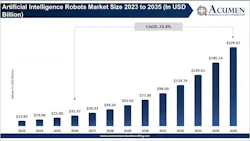
AI-driven, humanoid robotics, to be sure, has a place in plants of the near future. The global AI robots market was valued at $25 billion in 2025 and is projected to reach $229.7 billion by 2035, growing at a compound annual rate of 24.8%. But that curve tells a story of intent. It doesn’t tell you where the money investment actually is landing inside plants, which is the more useful question for operators today.
Where is AI actually creating value on the plant floor?
The most immediate opportunity is knowledge retention. Roughly a third of the manufacturing workforce is over age 55, and much of what they know—the sound a bearing makes right before it fails, the slight adjustment that saves a batch—was never written into a manual. It lives in their hands.
Manufacturers are now using AI to sit alongside experienced operators, recording how they troubleshoot and turning that into searchable guidance for newer hires.
Boston Dynamics' software leadership describes this as capturing hands-on, process-oriented knowledge that surfaces when a worker adapts to conditions that no manual anticipated.
Some firms are experimenting with letting a worker demonstrate a task directly to a machine instead of writing it up first, an early but useful fix for a problem that has no other answer once someone retires or moves on.
See also: DX is diminished if your workforce isn’t upskilled
Computer-aided manufacturing software has also begun embedding AI co-pilots that let machinists describe a problem in plain language and get a fix suggested back, cutting scrap while quietly logging expert reasoning for reuse.
Small models, big wins: Why bigger AI isn’t always better
A quieter shift is underway in what kind of AI plants are buying. General-purpose models suit drafting and broad questions, but on the shop floor the winning tools are small, narrow, and built for one job.
For example, a model trained only to spot scratches on one part beats a general vision model on speed and accuracy and runs on a camera at the edge instead of a distant data center.
Samsung Electronics applied a purpose-built system for defect detection in semiconductor manufacturing and recorded a 31% reduction in customer returns.
The worldwide edge AI market, valued at about $25 billion in 2025, is forecast to reach $170.6 billion by 2035 at a compound annual growth rate of 21.2%, according to Cervicorn Consulting, a rise driven largely by this preference for small, task-specific tools near the machine.
Why predictive maintenance keeps needing retraining
Predictive maintenance is often sold as a model you build once and let run. In practice, engineers are finding they need to retrain far more often than vendors promised.
A model trained only to spot scratches on one part beats a general vision model on speed and accuracy and runs on a camera at the edge instead of a distant data center.
Machine behavior shifted after the pandemic years, as supply substitutions and altered schedules changed the vibration and thermal patterns models had learned on older data. A model trained on 2019 readings can misfire against a 2026 line running different components at a different pace.
See also: Why industrial AI pilots fail: 5 mistakes that kill projects before they reach the plant floor
Renault reported 270 million euros in savings in a single year through predictive AI applied to energy use and maintenance scheduling, a figure that reflects what is possible when models stay current.
The global predictive maintenance market, worth $12 billion in 2025, is expected to surpass $113.9 billion by 2035 at a CAGR of 25.1%, according to Acumen Research & Consulting. Vendors rarely advertise how often recalibration is needed, but plants that skip it see accuracy quietly erode within a year.
How the U.S. is leading this shift
The United States shows this pattern most clearly, and the dollars are moving fastest here.
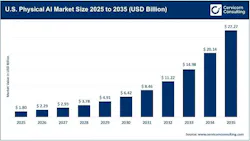
The U.S. physical AI market was valued at $1.81 billion in 2025 and is projected to reach $27.3 billion by 2035, a CAGR of 31.7%, according to Cervicorn Consulting. North America's broader AI market, valued at $122.3 billion in 2025, is expected to climb to $2.49 trillion by 2035.
Roughly 46% of U.S. manufacturers already use AI tools such as chatbots in daily operations, and more than 80% expect to expand use within two years, according to the National Institute of Standards and Technology. A separate survey found about 22% of manufacturers plan to deploy physical AI within the next year, more than double current levels.
Insurers are responding too!
In January 2026, standard policy forms introduced new liability exclusions for generative AI, and major U.S. insurance carriers, including Chubb, Travelers, and Berkshire Hathaway, won state approval to add similar exclusions to general liability and errors and omissions policies.
See also: Future of manufacturing still depends on human judgment
Stand-alone AI liability products have appeared from specialty insurers, with limits ranging from $2 million to $50 million, meaning the tool a vendor sold last year may no longer be covered this year.
Are businesses following the opportunity or just talking about it?
The honest answer is partial. A recent survey found 80% of manufacturers now allocate at least 20% of their technology budget to smart tools, yet only about one in five consider themselves ready to deploy AI at scale. Everyone is exploring, but few are executing.
Spending is also shifting away from generative chatbots toward narrower, deterministic tools. Quality operations data shows 47% of manufacturers use AI in quality processes, up from 33%, with defect detection and scheduling optimization the fastest growing uses.
See also: As AI adoption matures, data center controversies move to the fore
Adoption is also happening plant by plant rather than companywide. A plant manager in Ohio approving a scheduling optimizer often has no line to a counterpart in Texas doing the same thing, and corporate IT frequently learns about these tools after they are already running, creating governance gaps insurers and IT leaders are only now starting to notice.
The businesses pulling ahead are not the ones with the most ambitious AI strategy documents. They are the ones quietly retraining a maintenance model every quarter instead of every three years, buying a camera that does one job well instead of a platform that promises everything, and writing down what their most experienced people know before they walk out the door.
About the Author
 Mahima Sambre
Mahima Sambre
Mahima Sambre, a trained business journalist, is a market research writer and insights expert for Acumen Research and Consulting. She specializes in emerging technologies, industrial automation, artificial intelligence, robotics, and advanced manufacturing. She’s analyzing the rise of physical AI, tracking automation trends, or exploring the next wave of smart manufacturing.