As technician demand in manufacturing explodes, AI and adjacent industries could help
What you’ll learn:
- AI in factory IT and OT can close skills gaps and help ease and reshape the technician experience.
- Advanced manufacturing, maintenance and repair, and quality and laboratory technicians are expected to see among the most explosion in demand through 2030.
- Nearly 2 million techs in adjacent industries share skills and knowledge with manufacturing technicians, representing a future source of factory talent.
A Deloitte and Manufacturing Institute report might tell manufacturers what they already know very well: There aren’t enough technicians to go around for the available openings. And, the analysis finds, this problem is only expected to explode over the next five years.
As the title suggests, Deloitte’s Expanding the Skilled Manufacturing Workforce with AI, released Sept. 10, speaks much about how AI in factory IT and OT can close skills gaps and help ease and reshape the technician experience—from reimaging workflows to onboarding and career development to mobility, autonomy, and job satisfaction.
See also: Understanding connected worker solutions: Expectations vs. reality
However, the report has perhaps more to say about the scope of the challenges facing industry, especially in areas like advanced manufacturing, maintenance and repair, and quality and laboratory technicians that are expected to see the most explosion in demand through 2030.
“This research points to an important opportunity to use technology to expand pathways into manufacturing, accelerate skills development and give workers new tools to compliment the knowledge and judgment they bring to the job,” said Carolyn Lee, president of The Manufacturing Institute, which is the workforce development and education arm of the National Association of Manufacturers.
Key takeaways from the research include:
- Manufacturing technician employment could grow six times faster between 2025 and 2030, contributing to about 2.3 million estimated job openings across all industries, according to an analysis of Bureau of Labor Statistics data. More than 4.5 million workers were employed in 2025 in manufacturing technician roles and similar technician occupations outside of manufacturing across all industries.
- Nearly 2 million techs in adjacent industries share skills and knowledge with manufacturing technicians, representing a future source of factory talent. Those adjacent industries include construction; retail trade; wholesale trade; government; professional, scientific and technical services; transportation and warehousing; and information.
- The skills and knowledge required to fill the nearly half-million open manufacturing technician roles has led to a critical skills gap and remains a significant challenge for both manufacturers and aspiring manufacturing workers.
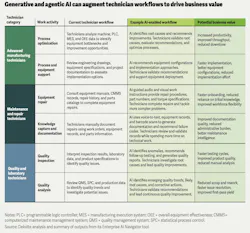
- Here’s where AI comes in: By digitizing technical knowledge and putting critical information at workers’ fingertips, it could help bridge skills gaps, reduce time spent searching for answers, empower workers transitioning from adjacent fields, and enable experienced manufacturing workers to focus on higher-value tasks.
“AI has the potential to change not only how manufacturing work gets done, but how people prepare for and succeed in these critical roles,” Lee said.
See also: DX is diminished if your workforce isn’t upskilled
Added Steve Shepley, industrial products and construction sector leader at Deloitte: “The industry now has the opportunity to redesign workflows, broaden pathways into technician roles, and give workers the support they need to develop and perform in more complex jobs. Organizations can consider deliberate investment in skills, trust and the workforce ecosystems that connect employers, educators and talent.”
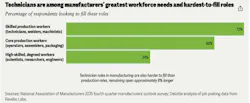
The Deloitte/Manufacturing Institute report points out that workforce challenges, like technician shortages, can “ripple through operations, increasing downtime and constraining production capacity, operational performance, and growth.”
See also: AI can't replace manufacturing’s biggest competitive advantage: Institutional knowledge
However, it notes, AI can embed expertise directly into daily work and can help workers—including those with less experience and others transitioning from adjacent industries—develop and apply knowledge and skills in manufacturing roles, thereby broadening the technician talent pool.
The Deloitte/Manufacturing Institute report went into some granular detail on how generative and agentic AI can help expand the skilled manufacturing workforce and ease any shortages:
About the Author
 Scott Achelpohl
Scott Achelpohl
Head of Content
I've come to Smart Industry after stints in business-to-business journalism covering U.S. trucking and transportation for FleetOwner, a sister website and magazine of SI’s at Endeavor Business Media, and branches of the U.S. military for Navy League of the United States. I'm a graduate of the University of Kansas and the William Allen White School of Journalism with many years of media experience inside and outside B2B journalism. I'm a wordsmith by nature, and I edit Smart Industry and report and write all kinds of news and interactive media on the digital transformation of manufacturing.