Relay research finds critical gaps in factory-floor information-sharing, leading to failures
What you'll learn:
- Relay’s survey of manufacturing professionals found major gaps in factory-floor information sharing.
-
Critical knowledge often remains undocumented.
-
Communication breakdowns contribute to downtime and recurring failures, with many reporting lost production from communication issues and few having a formal process to retain knowledge from departing workers.
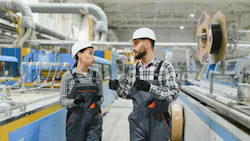
Manufacturing professionals across industries reported a lack of effective communication strategies in their factory operations, leading to missing context and costly failures, according to a recent report from Relay, maker of an operational intelligence platform.
The report identified two major operational issues: What the floor knows often goes unrecorded, so reports show what happened but not why; and when a system detects a problem, the alert often does not reach the person who can act on it in time.
See also: Why billion-dollar AI model claims fall apart on the factory floor
According to Relay, the crux of both of these problems is missing information. Getting an alert to the right person depends on worker availability, so that floor information has a chance of not being recorded.
Relay’s Factory Floor’s Missing Data Layer report, which surveyed 500 U.S. manufacturing professionals, found that only 20% of manufacturing professionals said their systems of record very accurately reflect what happens on a typical shift. Therefore, root cause analyses, capital plans, and site reviews rest on records that are only approximate.
Additionally, 57% of manufacturing professionals named in-person conversation as a main channel for critical information. According to Relay, this means that most of the context that explains a failure never reaches a searchable system.
And over 80% of respondents said that sensors and machine data alone are not fully sufficient to understand what is happening on the floor, so each failure that was spotted early but not acted on is downtime that could have been planned.
See also: Manufacturing’s hardest hire is the person running the automation
Across sites, the same pattern can repeat at each one, so that cost shows up as unplanned downtime, emergency repairs and recurring failures that reports can't explain, according to Relay.
Other key findings of the Relay report include:
-
82% relied on employees to pass information between teams, systems, or shifts by hand, so integration work is being done manually, adding labor cost and errors.
-
78% lost production to a communication breakdown at least a few times a month, causing lost output and longer repair times that are often missing from corporate reports and business cases.
-
Only 23% said their organization has a formal way to retain what departing workers know, leading to longer repairs and slower onboarding as experienced people retire.
-
Only 8% named data as the top barrier to scaling AI, so pilots built on incomplete records stall before they reach other sites, a cause often mistaken for an integration problem.
-
Executives and frontline workers often describe the same operation differently because they see different information. Problems the floor already knows about can take longer to get funding because they do not appear in reports.
Frontline workers carry information between disconnected systems, leading to missing information. This stops production most months as alerts often fail to reach the person who can act, the records that reach corporate leaders leave out the cause, site comparisons inherit those gaps without showing them, experience is retiring without being recorded and AI programs stall on problems that trace back to the same incomplete records.
Podcast: Scaling AI won't fix a shaky ERP foundation
According to Relay, the next gains in manufacturing performance are likely to come from keeping what the frontline already knows and getting that information to the person who can act on it, closing the information gap.
About the Author
 Sarah Mattalian
Staff Writer
Sarah Mattalian is a Chicago-based journalist writing for Smart Industry and Automation World, two brands of Endeavor Business Media, covering industry trends and manufacturing technology. In 2025, she graduated with a master's degree in journalism from Northwestern University's Medill School of Journalism, specializing in health, environment and science reporting. She does freelance work as well, covering public health and the environment in Chicagoland and in the Midwest. Her work has appeared in Inside Climate News, Inside Washington Publishers, NBC4 in Washington, D.C., The Durango Herald and North Jersey Daily News. She has a translation certificate in Spanish.