Manufacturing’s hardest hire is the person running the automation
What you’ll learn:
- A shop can fill an open position and still not have the capabilities to address their production backlogs.
- Manufacturing has a strong recruiting argument in job security.
- Own the skills that define your business. That includes the capabilities a shop uses every day and the work that sets it apart.
Manufacturers today have more work than they’re able to take on, but hiring hasn’t kept pace. Recent data from Xometry found that 77% of manufacturers are reporting higher production backlogs, yet only 59% plan to hire in 2027. Headcount is part of it, but the bigger gap is what new employees need to know once they’re in the door.
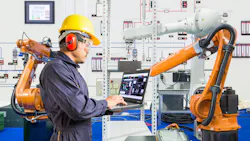
Industry has been here before, where jobs changed alongside their equipment. Machine operators, for example, who once loaded every part by hand, may now instead oversee a robot that does the loading.
See also: Why billion-dollar AI model claims fall apart on the factory floor
That operator still needs to know parts and processes, but now they also have to spot when the robot is off or not working and get it running again. AI and automation’s rise is bringing more jobs to the shop floor, yet there’s still a skills gap that exists to fill demand.
The hardest roles to fill: Between machines and software
Xometry found that AI and automation operators are now the hardest roles for manufacturers to fill, beating out quality engineers, maintenance technicians, machinists and CNC programmers.
Manufacturers still need machinists and programmers. They now also need people who can oversee automated systems, diagnose problems when those systems don’t act how they should, and keep equipment improving over time.
A shop can fill an open position and still not have the capabilities to address their production backlogs. The backlog only shrinks when the right skill is in that position.
A typical response to a skills shortage is to raise wages. This can work, but only to a point. A quarter of manufacturers say that raising pay produced no meaningful improvement in hiring or retention.
See also: Smart Industry's annual State of Initiative Survey is open!
So now, the story is more about which manufacturers this strategy works for. Among larger companies, 81% say raising pay improved retention.
For organizations with less than 200 employees, that drops to 46%, meaning that a large manufacturer can usually outbid the rest of the market when searching for automation specialists, but a small shop competing for the same candidate may not win out.
AI as the industry’s next recruiting pitch
Younger workers are already a big part of the workforce’s answer to these questions. The challenge is getting them to consider manufacturing in the first place.
Manufacturing has a strong recruiting argument in job security. In Xometry’s survey, 83% of manufacturers said they believe skilled trades are more resistant to AI displacement than typical white-collar office roles.
That tracks with how manufacturers are putting AI to work on shop floors today. The technology is making shops faster and speeding up production, but it still needs an experienced person to step in when something goes wrong.
Younger workers are already a big part of the workforce’s answer to these questions. The challenge is getting them to consider manufacturing in the first place.
For Gen Z, that creates an opportunity to put AI skills to work. In manufacturing, younger workers can use those skills to drive growth at companies that require having a human in the loop, especially with solutions and processes that are efficient but need human expertise to run smoothly.
Podcast: Takeaways from IFS Unleashed and how industrial AI is advancing
A younger worker who can troubleshoot an automated area of the process becomes the person who keeps manufacturing efficiency on track. The manufacturers that frame roles in this way, whether it’s in school recruiting partnerships, job postings or shop tours, will give Gen Z a reason to see the trades as a place to build their long-term career.
Decide what to own and what to develop
Even with stronger recruiting, backlogs can still grow faster than manufacturers can hire to clear them. A useful workforce plan for 2027 provides a clear view of which skills to own, which to develop internally, and which to bring in from elsewhere when the job calls for it.
My advice for shops is to own the skills that define your business. That includes the capabilities a shop uses every day and the work that sets it apart. A company’s core processes, quality standards, and knowledge of customer requirements are worth competing for and retaining.
Develop the skills that align with knowledge your team already has. For example, training a machinist to program and troubleshoot automated equipment is usually faster than an outside hire.
Deciding where a skill should come from starts with your backlog. Look at what work keeps getting delayed or turned away, and ask which skill is holding it up. Once you know that, ask how often you’ll need that skill and how long it would take to build.
See also: As technician demand in manufacturing explodes, AI and adjacent industries could help
A skill that’s needed every day but takes years to develop still belongs in-house, but a skill needed for one program this year may be better brought in rather than hired. Those answers will often shift as demand and programs change.
Plan for the work instead of an org chart
AI and automation will keep changing what manufacturing shop-floor work requires. As more production becomes automated, the people who run, check, and improve those systems are even more valuable to the business.
A useful workforce plan for 2027 provides a clear view of which skills to own, which to develop internally, and which to bring in from elsewhere when the job calls for it.
For manufacturing leaders heading into 2027, the hiring plan should start with two practical questions. First, which skills does our backlog depend on? And second, for each of those skills, do we need to own it, or develop it from within?
While the answers will vary widely between small, midsized and large businesses, no matter the size of the company, manufacturers that plan for those skills now will be better positioned to clear their backlogs, attract younger talent and get the most out of the technology they’ve invested in already.
About the Author
 Rachel Zepernick
Rachel Zepernick is the general manager of Thomas, a platform for connecting North American manufacturing buyers and suppliers. Prior to her current position, she carries more than 15 years of experience developing and executing growth strategies, delivering operational efficiencies that create lasting impact, and scaling marketplaces, in particular in industrial and home improvement industries.