ChatGPT won't run your plant, but here's what industrial AI needs instead
What you’ll learn:
- Many manufacturers actively trying to implement AI aren't quite ready for it yet.
- An engineer using ChatGPT or Copilot to analyze process data is still working from exports, not an automated flow of actionable data.
- The minimum threshold is an organization that has built real habits around treating data as part of operations rather than an occasional reference point.

Every manufacturer seems to be in the same conversation right now. How can we use AI on the plant floor? It's a fair question, and many operations are already starting to use artificial intelligence more in their day-to-day work beyond just writing emails. Pulling data exports, asking questions, or writing code, etc.
But there's a ceiling, and plants are hitting it faster than anyone expected. The problem isn't the AI. It's the data they have available for the technology to work with.
See also: Listen to Smart Industry's webinar also featuring Molly Culwell’s insights
Take the best case. Your company has an enterprise agreement, so your data isn't feeding into a public model. That handles the security piece, but it doesn't handle everything.
An engineer using ChatGPT or Copilot to analyze process data is still working from exports. They pull data into a spreadsheet, paste it into the tool, and ask what's driving a yield drop. The tool gives a reasonable answer, maybe even a useful one.
Now ask the same question two days later and you're starting over. There’s no memory of your plant, your process, your tags, or any context from the last conversation. Every session is a blank slate, the same process to do all over again.
Data freshness is the other issue. By the time you've exported, cleaned, and pasted, you're working with a snapshot. It can tell you what happened, but it can't tell you what's happening right now.
And plenty of companies don't have that enterprise agreement in place. Engineers using free or personal accounts often don't realize that data submitted through consumer versions can be used for model training and reviewed by the provider.
Podcast: 'Muddy waters' of implementing AI and how manufacturers can avoid them
For a plant handling proprietary process data or anything with regulatory sensitivity, that's a serious exposure, and compliance teams usually find out too late.
None of this means these tools have no place. They're doing what they were built to do. They just weren't built for this.
What the plant floor needs from AI
The plants that are seeing real results from industrial AI aren't using better prompts. They have a different setup entirely.
What makes their use cases work are live connections to the historian, not exports. The AI reads current data, which means it can answer questions about what's happening right now versus two hours ago versus last Tuesday.
Take the best case. Your company has an enterprise agreement, so your data isn't feeding into a public model. That handles the security piece, but it doesn't handle everything.
Their setups also know their plants, from tag names to units and asset framework. That context is loaded once and it carries across every question. You stop re-explaining your process and start just asking questions.
See also: As AI adoption matures, data center controversies move to the fore
Every response references the actual data or document it came from. In a plant environment, you need to be able to verify what you're acting on. An AI that sounds confident but can't show its work doesn't belong anywhere near an operator's screen.
Getting to this is about having the data infrastructure that makes all of it possible.
Where most plants stand today
Unfortunately, many manufacturers actively trying to implement AI right now aren't quite ready for it yet.
There's a widely used framework for thinking about digital maturity in manufacturing that breaks readiness into five stages.
Stage 1 is essentially no meaningful data collection at all. Stage 5 is a fully unified platform with no data silos and proactive, real-time decision-making across the organization.
The minimum threshold for AI to work reliably is Stage 4. That's the point where data is broadly accessible, people are using it to make decisions day to day, and the organization has built real habits around treating data as part of operations rather than an occasional reference point.
Most plants currently chasing AI projects are sitting at Stage 3. They have a historian. Engineers can review past performance. But silos still exist, tag naming is inconsistent, and half the organization still isn't looking at data unless something has already gone wrong.
See also: The fiber bottleneck nobody priced into the AI boom
Trying to run AI on a Stage 3 foundation tends to produce unreliable outputs, low adoption, and a general sense that the technology doesn't work. It does work. It just needed a better starting point.
What AI-ready actually means in practice
Reaching Stage 4 doesn't require an AI initiative. It requires getting five basic things right:
A historian that performs. High-speed data collection, no gaps, store-and-forward so nothing is lost when the network hiccups. Platforms like dataPARC or other Industrial Historians can give you what you need if configured and maintained properly.
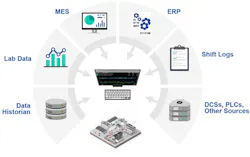
Data in one place. Lab data in a LIMS, production data in an MES, process data in the historian, none of it connected. That's the norm at a lot of plants, and it's what makes unified AI analysis impossible. A single environment where those sources feed in together is what changes the picture.
Tag quality. This one gets skipped most often. Consistent naming, useful metadata, and an asset hierarchy that matches how your plant is organized. Without that layer, AI can pull data but can't interpret what it means.
See also: Robotics isn’t having its ChatGPT moment just yet
Governance. Who can access what, and is there a record of how data was used? Role-based access and audit trails aren't just IT concerns. They're what makes AI answers something you can defend and act on.
Open integration. Plants built around OPC UA, REST APIs, and SQL connectors can plug in new tools without a months-long integration project every time. Proprietary, closed systems can't.
Get all five right and AI readiness is a byproduct, not a separate goal.
A few questions to determine your data foundation
Here are a few questions to ask to make sure your data foundation is set up before looking at an industrial AI tool:
- Can your team pull process data on their own, or do they wait on an export? If they wait, that's the first problem to solve.
- Would someone new understand your tag names without a legend? Inconsistent tagging is the fastest way to outputs nobody trusts.
- Do your data systems talk to each other, or does each one live in its own world? Partial data means partial answers.
- Are your people already using data to make decisions, or does it mostly get looked at after something goes wrong? AI amplifies the culture that exists. It won't build one from scratch.
The data is the hard part
There's a version of the AI conversation in manufacturing that treats the technology itself as the breakthrough. Get the right tool and improve things. That framing keeps a lot of vendors in business and leads to a lot of disappointed plant managers.
See also: Why industrial AI pilots fail: 5 mistakes that kill projects before they reach the plant floor
The plants getting value from industrial AI are not special because they found better software. They got there because their data was clean, their systems were connected, and their people were already in the habit of using data to make calls.
The AI stepped into an environment that was ready for it.
That foundation takes longer to build than a software purchase. But it's the only thing that makes the software worth buying in the first place. Start there and the AI question becomes a lot easier to answer.
About the Author
 Molly Culwell
Molly Culwell
Molly Culwell is a chemical engineer and Six Sigma Green Belt with more than a decade of experience in industrial data and operational analytics. She works at dataPARC, where she helps manufacturers turn complex process data into clear, actionable insights. She helped lead an Aug. 12 Smart Industry webinar, “Unlocking AI’s Potential: The Role of a Modern Data Ecosystem,” the replay of which is available for download.