How manufacturers are using digital twins to make real-time decisions
What you’ll learn:
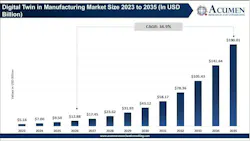
- The global digital twin in manufacturing market size was valued at $9.5 billion in 2025 and is predicted to reach $190 billion by 2035.
- North America leads the digital twin market with 35.6% share.
- The stakeholders who see returns treat a digital twin as an operations program, not an IT purchase.

For years, a digital twin was a showpiece, a polished 3D model that impressed visitors and sat idle once the demo ended. That era is over.
See also: Smart Industry's annual State of Initiative Survey is open!
Today, factories are wiring virtual replicas directly to live machines, sensors and supply chains, so that a decision made on a dashboard will change what happens on the shop floor within seconds.
The money is following the shift.
According to Acumen Research & Consulting, the global digital twin in manufacturing market size was valued at $9.5 billion in 2025 and is predicted to reach $190 billion by 2035, growing at a compound annual growth rate of 34.9% during the forecast period of 2026-2035.
That is a 20-fold jump in a decade, and it signals that plant managers no longer treat digital twins as an experiment.
From pretty model to living factory brain
A modern twin is not a drawing. It is a continuously updated mirror of a machine, a production line or an entire plant, fed by vibration sensors, energy meters, quality cameras and ERP data. When the mirror shows a bearing running 3 degrees hotter than normal, the system can slow the line, reschedule maintenance and reorder a part before a breakdown.
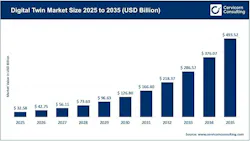
According to another analysis from Cervicorn Consulting, the global digital twin market size was valued at $32.6 billion in 2025 and is expected to be worth around $493.5 billion by 2035, exhibiting at a CAGR of 31.2% over the forecast period from 2026 to 2035, where North America leads the digital twin market with 35.6% share.
North America's 35.6% share is no accident. The U.S. combines three advantages: a deep base of industrial software vendors, large aerospace, automotive and semiconductor producers, and strong federal backing for domestic production.
The CHIPS and Science Act earmarked $52.7 billion for semiconductor manufacturing and research, and fabs are among the heaviest users of digital twins because a single hour of unplanned downtime can cost a plant hundreds of thousands of dollars.
Manufacturing contributes roughly 10% of U.S. GDP and employs about 13 million people. Federally supported Manufacturing USA institutes, including Chicago-based MxD, help suppliers adopt digital tools, and that matters because around 98% of U.S. manufacturers are small firms. Their adoption decides whether digital twins stay a big-company privilege or become standard practice.
Where the money Is going: a global investment map
Public money is flowing toward smart factories on every continent. These are the programs with a published budget. Germany (Industrie 4.0, since 2011), China (Made in China 2025, since 2015) and Japan (Society 5.0) pursue the same goal through national strategy and standards rather than one headline fund.
- U.S. CHIPS and Science Act, $52.7 billion, 2022 onward
- European Union Digital Europe Programme, 7.5 billion euro ($7.83 billion), 2021-2027
- India Production Linked Incentive schemes, about Rs 1.97 lakh crore (roughly $24 billion) 2020 onward, 14 sectors
Corporate numbers tell the same story. Siemens' 2024 downtime study estimated that unplanned stoppages cost the world's 500 largest companies about $1.4 trillion a year, close to 11% of revenue, with an hour of automotive line downtime near $2.3 million.
See also: Physical AI: Where opportunity really sits—now, today—for manufacturers
McKinsey has estimated that predictive maintenance can cut downtime by 30% to 50%. BMW has publicly described planning whole factories virtually, citing planning efficiency gains of around 30%.
Five real-time decisions that digital twins are making right now:
- Predictive maintenance: Parts are replaced when data shows wear accelerating, with 30% to 50% less downtime as the benchmark to chase.
- Dynamic scheduling: A rush order or late supplier triggers dozens of simulated schedules in minutes, and the best one wins.
- Energy optimization: Heavy loads shift to cheaper hours as power costs and carbon reporting rules tighten.
- Quality control: A defect is traced upstream to the exact setting that drifted, before more scrap is made.
- Worker safety: Robot and human movement is tested in a virtual cell before anyone steps onto the floor.
Legacy machines often lack sensors, data sits in disconnected systems, and cybersecurity risk rises when a plant joins the network. Skills are scarce, too, since few teams combine operations know-how with simulation and data engineering.
What smart industry stakeholders should do next: a 12-month playbook
The leaders who see returns treat a digital twin as an operations program, not an IT purchase. This sequence fits a single budget cycle.
Days 1 to 30: Choose one costly problem
Rank assets by cost per hour of downtime, scrap rate and energy use, then pick the line where those three add up to the biggest loss. Record baselines for unplanned downtime, first-pass yield and kWh per unit, because without them nobody can prove savings later.
Days 31 to 90: Connect and clean the data
Audit which machines already stream data and which need retrofit sensors, which usually cost far less than new equipment. Link maintenance, quality and scheduling records into one source, and insist on open data standards so you are not locked into one vendor.
Days 91 to 180: Run a live pilot with a hard target
Set a measurable goal, such as a 20% cut in unplanned stops on the pilot line within six months, a cautious figure against the 30% to 50% benchmark. Keep a human approval step at first, then let the digital twin act alone on low-risk decisions like energy load shifting.
Days 181 to 365: Scale and secure
Replicate the model on similar lines, then in a second plant. Segment the factory network, set access rules for the twin and review them every quarter. Name one team of engineers, data and operations staff who own the results.
See also: Particulars of 'software-defined' transformations, courtesy of digital twins
The scorecard you should be able to show your board:
- Unplanned downtime hours, month over month
- First-pass yield and scrap cost
- Energy used per unit produced
- Payback period on the pilot line, with under 18 months as a sensible aim
Digital twins have stepped out of the presentation room and into the control loop. With market forecasts pointing toward $190 billion for manufacturing alone by 2035, and governments from Washington to New Delhi backing factory modernization, the question is no longer whether to build a twin. It’s how quickly your plant can let its digital twins make decisions that matter.
About the Author
 Mahima Sambre
Mahima Sambre
Mahima Sambre, a trained business journalist, is a market research writer and insights expert for Acumen Research and Consulting. She specializes in emerging technologies, industrial automation, artificial intelligence, robotics, and advanced manufacturing. She’s analyzing the rise of physical AI, tracking automation trends, or exploring the next wave of smart manufacturing.