New IFS product grabs industrial data for a single, AI-powered interface
What you’ll learn:
- IFS Intelligence collates data from all types of industrial assets, systems, and processes.
- Industrials have learned to operate with unfulfilled capacity, a lost 40% that IFS officials cited.
- IFS Intelligence can help recover the lost 40%, they said.
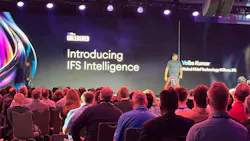
ORLANDO, Fla.—IFS CEO Mark Moffat kicked off his company's big Unleashed show for customers and media here on Oct. 13 by noting that industrials on average are only using about 60% of their organizational capacity, leaving as much as 40% untapped.
“Where is your 40%?” he asked during his keynote in front of hundreds of attendees.
Moffat and his cohorts from the global manufacturing software maker said they think they have a solution: a complex yet efficient offering called IFS Intelligence, which the company claims is a new way to “apply AI to industrial challenges that technology previously could not solve.”
See also: New IFS study reveals gap between AI strategy in the C-suite and actual factory-floor usage
IFS Intelligence, company officials said here, can collate data from all types of industrial assets, systems, and processes all around an operation and turn that information into actionable tasks that flows through one conversational interface.
Industrials have learned to operate with lost capacity: unplanned downtime has a target, missed first-time fixes are built into service plans, and scrap has an allowance, the company said.
Many of those losses trace back to the tech they run on: Systems that do not talk to each other, screens that take months to learn, implementations that take years, and the spreadsheets and workarounds people build to bridge the gaps.
Podcast: Realizing the full potential of connected worker solutions in the AI era
“The missing 40% is already inside the business,” Moffat added in a release on his new IFS Intelligence product. “It sits in the expertise of the control room, the knowledge of the night shift, and the data spread across every system.
“IFS Intelligence brings all of it together and puts it to work. People can ask a question, take action, or hand a task to a ‘digital worker,’ all within the rules, permissions and approvals that govern their business. That is how industry closes the gap.”
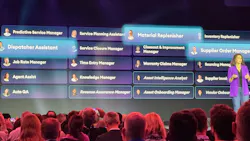
IFS ‘digital workers’ become an expanded agentic workforce
About a year ago, IFS introduced agentic “digital workers” as part of its IFS Loops product. On Tuesday, Loops CEO Somya Kapoor was back onstage explaining how Loops plays a role in its IFS Intelligence product, along with three other component products: Cowork, Runway along with another, AI Harness.
Podcast: Do manufacturers dream of 'digital workers'?
Kapoor explained that many more “job titles” have been added to Loops, so much so that “digital workers” have become an entire workforce with titles such as predictive service manager, dispatcher assistant, job rate manager, service planning assistant, service closure manager, time entry manager, material replenisher, and warranty claims manager.
As Kapoor explained last year, Loops can free the labor force by autonomously managing more mundane but high-volume tasks.
As part of IFS Intelligence, tasks can be delegated through Loops, handing defined workflows to digital workers that run in the background and escalate when judgment or approval is needed. Teams can even build their own digital workers in yet another IFS product, Agent Studio, introduced this spring, so capacity can grow without waiting on hiring.
The missing 40% is already inside the business. It sits in the expertise of the control room, the knowledge of the night shift, and the data spread across every system. IFS Intelligence brings all of it together and puts it to work.
- IFS CEO Mark Moffat
The backbone of IFS Intelligence, the company said in its release, is industrial AI, and the platform gives people two other ways, besides delegating in Loops, to put that AI to work:
- Ask and act with Cowork: Question live operational data in plain language, investigate problems and prepare actions that run only once a person provides approval. Any answer can become a Lens, a live view that keeps updating as the operation moves, and work that succeeds once can be saved as a Skill for anyone to repeat. Cowork also reaches connected systems such as Microsoft 365 through MCP.
- Extend with Runway: Use plain-language requirements to speed up the migration, configuration and extension of IFS, with less implementation effort and less risk.
Underneath all three, the IFS industrial AI Harness applies the context and controls that industrial operations require.
Early use cases with IFS Intelligence
IFS cited early instances of customers who are utilizing their new platform.
In one, a production manager learned that a large order due next quarter was at risk. Finding out why, and what to do about it, meant connecting inventory, production capacity, supplier commitments, logistics constraints and the financial impact of delay.
See also: How manufacturers are using digital twins to make real-time decisions
With IFS Intelligence, one question can identify the risk, surface likely causes and recommend the next action, which the manager can approve and set in motion. What used to take several reports, systems and specialists, or might not have even been possible, becomes one governed flow from question to action.
Curtis Taylor, chief business operations officer at Tampa, Florida-based Sims Crane & Equipment, which operates branches across Florida and Georgia, said: “I was literally building skills and working out how to make our operational data actually accessible to our teams, piece by piece, when I saw IFS Intelligence.”
He added: “That changed the conversation entirely. Out of the box, all the data in our systems can be surfaced to our people. They can ask questions about our fleet, which cranes would be best to meet a particular customer requirement, for example, maximizing our fleet efficiency.”
About the Author
 Scott Achelpohl
Scott Achelpohl
Head of Content
I've come to Smart Industry after stints in business-to-business journalism covering U.S. trucking and transportation for FleetOwner, a sister website and magazine of SI’s at Endeavor Business Media, and branches of the U.S. military for Navy League of the United States. I'm a graduate of the University of Kansas and the William Allen White School of Journalism with many years of media experience inside and outside B2B journalism. I'm a wordsmith by nature, and I edit Smart Industry and report and write all kinds of news and interactive media on the digital transformation of manufacturing.