Sphera stakeholder pushes for tech intervention as 10% labor losses loom by 2035
What you'll learn:
- Sphera research found that 59% of manufacturers likely will see at least 10% of their workforce retire by 2035, showing a need to shift towards technology solutions to help make up for this shortage.
- To fill this gap, respondents said contractors now make up more than 10% of the workforce, introducing inconsistency in safety procedures.
- Despite challenges in implementing technology, one expert said, solutions can be put in place to ensure safety and make enforcement more consistent.
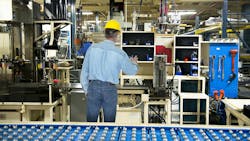
Recent research has revealed that 59% of manufacturers likely will see at least 10% of their workforce retire within the next decade, indicating a shift towards using technology to make up for this shortage, despite some significant implementation challenges.
Sphera, a Chicago-based operational risk software company, found this problem when it surveyed 841 manufacturing supervisors between Sept. 25 and Nov. 17, 2025, revealing the workforce loss of those employees ages 55 and over, who, industry observers fear, will take decades of critical knowledge with them out the door.
See also: Executives advocate for reshaping of workforce following job cuts from AI
The Sphera research also revealed another finding of note: Contractors are and will help ease the employee losses, but that uneven enforcement of safety procedures is an unfortunate byproduct of this trend.
“This is more than a demographic trend,” Iain Mackay, Sphera’s senior VP of process safety management, wrote in an op-ed given to Smart Industry. “It is a drain of operational judgement and knowledge built through years of exposure to real-world volatility on the factory floor.”
See also: The Crystal Ball Series 2026
Mackay highlighted the importance of institutional expertise in maintaining safety: “That knowledge includes the instinct to recognize early warning signs of safety risks before alarms trigger, and the informal problem-solving that keeps operations stable when conditions shift.”
And he added: “When experienced workers leave, organizations lose institutional memory and with it a critical layer of operational resilience that carries safe operations.”
To fill this gap, roughly one third of organizations surveyed by Sphera also said contractors now make up more than 10% of the workforce, introducing variability to safety procedures.
However, Mackay wrote that leaning on contractors can lead to “small inconsistencies” building up over time, creating challenges and risks of uncertainty heightened by a lack of visibility. Of the respondents, 58% said that they have good visibility into safety-critical data but admit gaps remain, and 15.5% said their visibility is limited.
As a result, manufacturers are turning to technology to fill these gaps, with 82.5% of supervisors saying that safety-related technology has improved their ability to manage process safety.
It is an early warning that knowledge loss can become a safety risk in its own right and that modern safety management is now an operational differentiator.
- Iain Mackay, Sphera senior VP of process safety management
“This is where technology can support the transition in a practical way. Not by replacing people, but by making safe decisions easier to repeat across teams with mixed experience," Mackay wrote.
He added: "More than 82% of supervisors say safety-related technology has improved their ability to manage process safety. They are helping standardize procedures, surface early warning signs and reduce the reliance on informal knowledge that may no longer be there.”
See also: Crystal Ball 2026: The year AI moves from promise to production
Both Mackay and the research emphasized that there is still “a clear gap between how fast operations are changing and how quickly many organizations update the rules meant to keep workers safe,” with more than a third of organizations reviewing process safety procedures only once per year.
However, he wrote that there are solutions to these challenges when implementing technology, emphasizing that as the workforce shifts, safety technology must also evolve.
Some solutions he pointed to include making critical knowledge searchable as digital decision guidance and training that sits at the point of use; system-enforced controls in contractor safety training; and making safety governance able to move at software speed.
“Manufacturers need continuous visibility from leading indicators, real-time workflow data and feedback loops that flag weak signals early, so procedures evolve as the work changes, with traceability built in,” he wrote.
See also: Turning workforce challenges into digital opportunities
He urged organizations to pay attention to their aging workforce: “It is an early warning that knowledge loss can become a safety risk in its own right and that modern safety management is now an operational differentiator.
"Investing now in people, process, and the technology that makes safe work repeatable will protect both their workforce and their operations. Those that delay may find safety and resilience slipping away quietly, long before it shows up in safety incidents.”
About the Author
 Sarah Mattalian
Sarah Mattalian
Staff Writer
Sarah Mattalian is a Chicago-based journalist writing for Smart Industry and Automation World, two brands of Endeavor Business Media, covering industry trends and manufacturing technology. In 2025, she graduated with a master's degree in journalism from Northwestern University's Medill School of Journalism, specializing in health, environment and science reporting. She does freelance work as well, covering public health and the environment in Chicagoland and in the Midwest. Her work has appeared in Inside Climate News, Inside Washington Publishers, NBC4 in Washington, D.C., The Durango Herald and North Jersey Daily News. She has a translation certificate in Spanish.