Adoption of automation, AI-powered tools accelerating across sectors, survey shows
What you'll learn:
- A survey of 400 U.S. companies shows accelerating automation of back-office and production processes to boost output, secure supply chains and support a renewed push for domestic manufacturing.
- Nearly 95% of U.S. industrial businesses plan to introduce new automation within the next three years, signaling a major shift in how American industry operates.
- This trend is likely to accelerate, with 76% of companies saying they’re very likely to introduce new automation in the next three years.
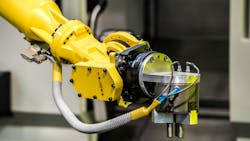
A survey of 400 U.S. companies revealed key insights on a drive towards physical automation equipment such as robotics and other AI-powered automation tools, showing that companies across sectors are either already using this technology or are planning to do so.
See also: Executives advocate for reshaping of workforce following job cuts from AI
The findings come from the German modular robotics company RobCo and its Automation Readiness Index, a survey of 400 U.S. business leaders in sectors including manufacturing, construction, engineering and health care, conducted by technology and B2B market research agency Sapio Research to address how warehouses and factories are paying for automation, and what’s blocking the next wave of robots in those sectors.
The data shows U.S. companies accelerating automation of back-office and production processes to boost output, secure supply chains and support a renewed push for domestic manufacturing, according to a release from RobCo.
According to survey findings, nearly 95% of U.S. industrial businesses plan to introduce new automation within the next three years, signaling a major shift in how American industry operates, according to RobCo.
The survey showed that automation is already well underway, with 47% of respondents already using some form of AI-powered automation, and 94% having at least partly integrated their physical and digital systems, connecting factory machines to computers for tasks like monitoring production.
According to the research, this trend is likely to accelerate, with 76% of companies saying they’re very likely to introduce new automation in the next three years. Among companies already using automation, over half reported increased productivity, time savings, reduced waste and improved resource efficiency.
Research yields four main findings
First, high capital expenditures are still the leading brake on adoption, with almost half of respondents citing high upfront investment costs as the main reason why they haven’t implemented more automation.
See also: AI that augments the workforce … and doesn’t replace it
Of the respondents, 48% said that high initial investment—including traditional funding models requiring high investment in physical robotics assets and third-party vendors for integration and maintenance—is holding them back, and 27% said a lack of internal know-how is an additional obstacle.
This was the case even though many already rated current automation spend as “high,” according to RobCo.
Also, payback expectations are high, with most respondents looking for a one- to two-year ROI, with the average target falling around 16 months, although manufacturing was even tighter.
See also: Inside the rise of manufacturing ‘co-intelligence’ in real factory operations
And financing preferences are shifting toward operating expenditure, with about 50% of respondents pointing to leasing or operating leases. Additionally, many are exploring state or federal grants, and over 40% said they would consider a robots-as-a-service model that bundles hardware, software, and support into a recurring fee.
Robotics-as-a-service (RaaS) is a concept that broadly refers to robotics providers that do not simply sell their products, but rather rent or lease their products with solutions to customers as a full service.
“Modern robot-as-a-service models offer companies an attractive opportunity to significantly lower the barriers to entry into automation. Instead of high initial investments, companies pay predictable monthly or usage-based fees, thus avoiding long-term risks," Roman Hölzl, CEO and co-founder of RobCo, said in the release.
See also: AI adoptions help push monthly industrial job losses to 20-year high
The most automation-mature companies are the most open to RaaS, RobCo found, with those already deep into automation indicating they are more willing to adopt RaaS and revenue-share models than less developed companies.
According to RobCo, this suggests that once factories understand true lifecycle costs, they’d rather buy outcomes than equipment.
According to the survey, 42% of companies said they see increasing employee satisfaction as a key motive in adopting automation.
See also: Taming the data beast is the first step toward smart operations that cannot be skipped
According to the research, the drive towards physical automation is in part a result of the push to expand domestic production, although Deloitte warned of a workforce bottleneck.
While 3.8 million industrial jobs will be needed to meet demand, the U.S. is likely to face a shortfall of 1.9 million workers, although automation might be able to fill that gap.
About half of businesses see automation to improve operational efficiency, enhance data accuracy and reporting and reduce manual errors, according to the survey.
About the Author
 Sarah Mattalian
Sarah Mattalian
Staff Writer
Sarah Mattalian is a Chicago-based journalist writing for Smart Industry and Automation World, two brands of Endeavor Business Media, covering industry trends and manufacturing technology. In 2025, she graduated with a master's degree in journalism from Northwestern University's Medill School of Journalism, specializing in health, environment and science reporting. She does freelance work as well, covering public health and the environment in Chicagoland and in the Midwest. Her work has appeared in Inside Climate News, Inside Washington Publishers, NBC4 in Washington, D.C., The Durango Herald and North Jersey Daily News. She has a translation certificate in Spanish.