Podcast: Why manufacturing AI is moving closer to the edge
What you'll learn:
- Edge AI enables low-latency predictive maintenance and real-time industrial decision-making.
- AI governance now requires lifecycle management, monitoring, rollback, and model traceability.
- Manufacturers use AI for quality inspection, anomaly detection, and production optimization.
- Maintenance teams will play a key role managing AI-enabled assets and operational oversight.
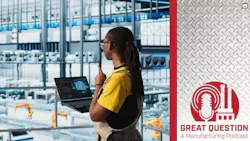




For this episode of Great Question: A Manufacturing Podcast, our colleague Thomas Wilk speaks with Andy Foster, chief product officer at IOTech, about the growing use of edge AI across discrete manufacturing, process manufacturing, and energy operations.
See also: Rockwell report: Days of ‘experimentation’ are over, DX is here to stay
What is edge AI? This refers to deploying artificial intelligence algorithms directly on local devices (like sensors, cameras, and industrial controllers) on the factory floor itself, rather than sending data to a centralized cloud. This allows machinery to process data and make decisions locally in real time.
Below is an excerpt from the podcast:
Thomas Wilk: Hi, everyone, and welcome to a new episode of Great Question: A Manufacturing Podcast brought to you by Endeavor Business Media's Manufacturing Group. Today with us, we have Andy Foster, who is the chief product officer at IOTech, and he spent more than 25 years developing IoT and distributed real-time and embedded software products.
See also: Why IT/OT initiatives fail when executive engagement stops at sponsorship
Andy's with us to talk about a pressing trend with industrial artificial intelligence, a trend in which energy operators are moving quickly to use AI closer to the edge. So, Andy, everyone on the podcast seems to want to know more about AI. Thank you for being with us today.
Andy Foster: Thank you, and it's a pleasure joining you today.
TW: You know, let's take a very short step back and talk more generally about where you see AI being adopted in a few key verticals, where and how. Most of our listeners operate in the discrete manufacturing, process manufacturing, and energy sectors. So, in your experience, can you talk about where and how you see AI being drawn into these sectors?
AF: Sure, in fact, we service customers in all three of those key sectors, and AI is being used in different degrees and in different formats and forms across all of those different verticals.
If I start with discrete manufacturing, we see a number of different use cases. We see everything from AI being used to optimize production cycle times and orchestrate flexible production lines—and I'm talking about things like robot path optimization—but in the discrete space, I would say that there's a couple of use cases in particular that are basically growing the fastest, and that's to do with things like detecting quality deviations of materials as they're moving through the production lines.
That involves the use of things like vision inference, so cameras to detect problems through the manufacturing process. That's a very key use case, which has actually been used for quite a while now, so it's widely deployed and widely tested. And I think probably the other key use cases are around the actual equipment itself. So, detecting potential faults in the equipment in advance of the machinery actually failing in the discrete space.
I also see, obviously, similar types of things in terms of predictive maintenance and anomaly detection in the process space. But we also see AI being used to detect anomalies in continuous operations and also to do things like optimize control loops to try and maximize the yield in process manufacturing. Small changes and optimizations can have a big impact on cost. So that's a key use case we see there.
Smart Industry E-handbook: DX-AI-IIoT
And then switching across to the energy space, there's a number of different areas, key areas where AI is being used in the energy space. Now, again, as in common with the other two, things like predictive maintenance and fault detection are key because these are large distributed systems which are equipment rich, so those type of use cases are very common.
But AI has also been used heavily to enable what we call DER (distributed energy resource) orchestration. So, managing and optimizing systems of different types of energy assets and resources, grids of these, to basically allow them to coordinate and operate more efficiently.
We're seeing AI models being used in some of our specific parts of the energy space, things like battery energy storage for modelling battery degradation, and again, fault analysis and predictive maintenance of the physical equipment.
But also other use cases which are used particularly for optimization, it's things like inverter control optimization. So being able to use AI to determine the most optimum times to charge your batteries, for example, when the environment considerations are most optimum.
See also: How OEMs are reimagining vehicle inspection—and AI’s role in this transformation
For example, if the wind's blowing or the sun's shining, and then perhaps discharge your battery, you know, by controlling the inverter when maybe the market conditions are the most advantageous to the operator. So yes, we're seeing, you know, AI is being used across all of the domains that you mentioned, particularly for doing things like fault diagnosis and maintenance.
Particularly, I guess, if you could categorize that, AI has particularly been used for optimization, analysis and monitoring type of applications. That's because it's because of the characteristics of the systems. That's where it's, I guess, it's the safest type of place to use them within the operation. So not directly into the safety critical control loops and things like that.
About the Author
 Scott Achelpohl
Scott Achelpohl
Head of Content
I've come to Smart Industry after stints in business-to-business journalism covering U.S. trucking and transportation for FleetOwner, a sister website and magazine of SI’s at Endeavor Business Media, and branches of the U.S. military for Navy League of the United States. I'm a graduate of the University of Kansas and the William Allen White School of Journalism with many years of media experience inside and outside B2B journalism. I'm a wordsmith by nature, and I edit Smart Industry and report and write all kinds of news and interactive media on the digital transformation of manufacturing.